Listen up, Australia. I am pretty sick of our recent political environment. We do not have to do extreme right, religious conservatism and introduce a sudden pro-gun agenda just because America does those things, okay?

Showing posts with label economics and finance. Show all posts
Showing posts with label economics and finance. Show all posts

Mar 21, 2016
What Journalism Has In Common With Stockbroking
I'll dispense with the preamble. What journalism has in common with stockbroking is this:
An old model which was well established and profitable is transitioning with a lot of pain to a new model, which everyone is still trying to figure out.
The old model was comfortable and cushy (for those at the top). The new model is a major change, culturally, psychologically and commercially, and it is not yet - but one day will be - profitable.
Another month in Australia, another horrible rupture for Fairfax. If I was a journalist I would probably write "the embattled Fairfax". After already pruning itself back in 2012 and again in 2013, this week the company announced it will cut the equivalent of 120 full-time jobs from its newsrooms.
That's a lot of journalists. It's hard to imagine the company even has that many jobs left to spare. (And according to staff, they don't).
And I really feel for Fairfax. Not only because I love The Age and am a subscriber who reads it every day, but because I think in very difficult circumstances they have been forging an evolution towards an online model quite well.
New media is great. But blogs and tweets and news fragments do not fill the gap left by traditional newspapers. New media still needs journalists to write the stories, and "citizen journalists" just aren't as good.
Of course, we will get used to it. Just as we have got used to the passing of great puns in headlines (largely gone in favour of SEO), and elementary grammatical and syntax errors in broadsheet news (now that sub-editing, like everything else, is outsourced to cheap workers overseas). We got used to those things, and the world didn't collapse.
So, there is no choice - citizen journalists it shall be, and the real journalists will find work somewhere, somehow, in this new cacophony. Not all the ones being let go now, unfortunately, but future ones will.
Somehow I don't think either the paid subscription model used by most newspapers and journals online now, or the Buzzfeed model, will be the lasting profitable solution.
I wonder what it will be?
Stockbroking has always been a world of boom and bust, but ever since the 2008 crash and the Great Recession that followed (or still follows), it's been all bust. The stockbroking model as it was before then has truly broken and is never coming back. That's probably even a good thing.
Since 2008, it's been impossible to squeeze money out of traditional stockbroking. The margins are too thin; no one wants to pay for brokerage and research when they can get what they need online.
In Australia the ASX has piled more and more compliance obligations on brokers, and ever-higher liquid capital requirements to guard against insolvency collapses. In classic Law of Unintended Consequences style, the result has been an explosion of "shadow brokers" - small and nimble dealing and advisory businesses that range from serious, ethical companies with management and due process, to guys operating out of their loungerooms with, let's just say, less than that.
In the last decade that I worked in broking operations, I watched these companies come and go, the same people moving from license to license and company to company in a never-ending scramble to find some way to make money. Most of these people are straight up, love broking and just want to make money for their clients and themselves - but the landscape is unforgiving.
So now everyone knows the future is "online". The future is "robo-advice" (less risk of non-compliant customer management or advice), and "fintech".
But what is the best kind of company to run? What's the best service to offer: advice to customers, or services to dealers? How do you innovate and create a solution, and not be copied by a thousand imitators with the same access to the cloud that you have?
Time will tell.
I'd love to step 5 years into the future and see what's happening in both journalism and financial services. My guess is both will be profitable, but not exactly in ways people are building them now. The future will come up with something else.
Disclaimer: I work in FinTech and love it. :)
An old model which was well established and profitable is transitioning with a lot of pain to a new model, which everyone is still trying to figure out.
The old model was comfortable and cushy (for those at the top). The new model is a major change, culturally, psychologically and commercially, and it is not yet - but one day will be - profitable.
 |
| Sira Anamwong/freedigitalphotos.net |
Journalism:
That's a lot of journalists. It's hard to imagine the company even has that many jobs left to spare. (And according to staff, they don't).
And I really feel for Fairfax. Not only because I love The Age and am a subscriber who reads it every day, but because I think in very difficult circumstances they have been forging an evolution towards an online model quite well.
New media is great. But blogs and tweets and news fragments do not fill the gap left by traditional newspapers. New media still needs journalists to write the stories, and "citizen journalists" just aren't as good.
Of course, we will get used to it. Just as we have got used to the passing of great puns in headlines (largely gone in favour of SEO), and elementary grammatical and syntax errors in broadsheet news (now that sub-editing, like everything else, is outsourced to cheap workers overseas). We got used to those things, and the world didn't collapse.
So, there is no choice - citizen journalists it shall be, and the real journalists will find work somewhere, somehow, in this new cacophony. Not all the ones being let go now, unfortunately, but future ones will.
Somehow I don't think either the paid subscription model used by most newspapers and journals online now, or the Buzzfeed model, will be the lasting profitable solution.
I wonder what it will be?
Stockbroking:
Stockbroking has always been a world of boom and bust, but ever since the 2008 crash and the Great Recession that followed (or still follows), it's been all bust. The stockbroking model as it was before then has truly broken and is never coming back. That's probably even a good thing.
Since 2008, it's been impossible to squeeze money out of traditional stockbroking. The margins are too thin; no one wants to pay for brokerage and research when they can get what they need online.
In Australia the ASX has piled more and more compliance obligations on brokers, and ever-higher liquid capital requirements to guard against insolvency collapses. In classic Law of Unintended Consequences style, the result has been an explosion of "shadow brokers" - small and nimble dealing and advisory businesses that range from serious, ethical companies with management and due process, to guys operating out of their loungerooms with, let's just say, less than that.
In the last decade that I worked in broking operations, I watched these companies come and go, the same people moving from license to license and company to company in a never-ending scramble to find some way to make money. Most of these people are straight up, love broking and just want to make money for their clients and themselves - but the landscape is unforgiving.
So now everyone knows the future is "online". The future is "robo-advice" (less risk of non-compliant customer management or advice), and "fintech".
But what is the best kind of company to run? What's the best service to offer: advice to customers, or services to dealers? How do you innovate and create a solution, and not be copied by a thousand imitators with the same access to the cloud that you have?
Time will tell.
I'd love to step 5 years into the future and see what's happening in both journalism and financial services. My guess is both will be profitable, but not exactly in ways people are building them now. The future will come up with something else.
Disclaimer: I work in FinTech and love it. :)
Aug 7, 2015
Fixing MP Entitlements
The politicians are saying the problem is the rules are too opaque, and they need to be made clearer. I guess they need rules where they are not tempted to push the definitions of what is allowed to the absolute limit of shameless logic-twisting, intention-denying interpretation, just because everyone else in the parliament is doing it too.
In fact all this really needs is leadership: one decent PM who will say, at the beginning of his or her term in office, "Look, let's stop all this nonsense and all agree to just claim the bare minimum, and let me set up someone whose task it will be to check what you're claiming and disallow anything that would make a reasonable person go, 'Well, that's not reeeeally what the designers of this entitlement had in mind...' "
But since we don't have that, sure, I guess we need to tighten the rules and make them "more transparent". So fine, it's not that hard. In fact, the existing rules are actually pretty clear, except for spelling out what is an allowable business trip.
But ok, here are my new rules:
Travel and Accommodation:
NOT HARD.
I also think it's a good idea as someone has suggested, to rename them from 'entitlements' to 'expenses' or 'claims'. If you are told something is an 'entitlement', you are apt to claim it. Just as many taxpayers routinely put in work expense claims for the couple of hundred dollars' stationery claims you are allowed to make without receipts - and can I just add, that I also think this is appalling. Don't do it, people.
In fact all this really needs is leadership: one decent PM who will say, at the beginning of his or her term in office, "Look, let's stop all this nonsense and all agree to just claim the bare minimum, and let me set up someone whose task it will be to check what you're claiming and disallow anything that would make a reasonable person go, 'Well, that's not reeeeally what the designers of this entitlement had in mind...' "
But since we don't have that, sure, I guess we need to tighten the rules and make them "more transparent". So fine, it's not that hard. In fact, the existing rules are actually pretty clear, except for spelling out what is an allowable business trip.
But ok, here are my new rules:
Travel and Accommodation:
- Business Class air travel is fine
- no charter flights or helicopters unless there is no commercial flight
- no air miles can be accrued (the same rule some companies have for business travel)
- you pay for any family traveling with you
- taxis or hire cars for urban travel but not for travelling between home and your electorate office
- no travel allowance for party fundraisers or social events
- if you have a "work meeting" at the same place as a social event, you pay half the travel cost (and travel rules as above still apply)
- you can't use your accommodation allowance to pay off your mortgage on a Canberra home. Yes you might have bought the home because you have to spend part of the year in Canberra for work, but the fact you are buying it gives you a personal financial advantage (property wealth) so you can't DOUBLE-DIP by claiming an allowance as well.
- To achieve the above, change the flat dollar allowance MPs get for accommodation and food while in Canberra to two separate items, being a flat amount for food and a claim for accommodation, which is only paid for booked-and-paid accommodation
Study Tours:
- Stop that nonsense
Superannuation:
- Same as the rest of us
Retirement allowances:
- existing redundancy arrangements for MPs who lose their seat are fine
- no funded office or driver. Use a home office
- Scrap the Gold Pass arrangements for free air travel within Australia for retired long-serving MPs - it's encouraging too many of them to stick around for too long. Let's make it 3 free Business Class trips a year for self and spouse, to attend the odd thingy.
NOT HARD.
I also think it's a good idea as someone has suggested, to rename them from 'entitlements' to 'expenses' or 'claims'. If you are told something is an 'entitlement', you are apt to claim it. Just as many taxpayers routinely put in work expense claims for the couple of hundred dollars' stationery claims you are allowed to make without receipts - and can I just add, that I also think this is appalling. Don't do it, people.
There has been unhappiness about MP entitlements before, but this time it's the current government's own harsh budget and rhetoric ("The age of entitlement is over!" - oh, I love it) combined with Hockey's out-of-touch announcements ("poor people don't drive far", "people should get a good job paying good money") combined with the usual dubious expense claims by all of them, that is bringing this to a head.


To finish off: this is the funniest Bronwyn Bishop helicopter meme in my opinion:
Bronwyn Bishop says goodbye.
#auspol pic.twitter.com/VuIQbpqY9q
— Tim Jones (@forthleft) August 2, 2015
Jun 12, 2015
Belt-tightening 101: the answer
I've been thinking about the question I posed yesterday: why don't politicians trying to convince the public on the need to cut spending cut some of their own salary or allowances to win hearts and minds?
And I think I know the answer.
In a parliamentary system one of the hardest jobs the leaders have is to rally, control and maintain unity among their MPs. These may include members who've worked very hard to win marginal seats, members on the back bench not earning big bucks, members already getting disillusioned or embittered and members on the rise looking for any excuse to either jump ship or try and take your job.
Most governments try and do the cost-cutting early in their term, aiming to get the pain - and public anger - out of the way early and betting that the electorate will have forgiven and moved on by the time of the next election.
So the most important hearts and minds the leaders need to win during this sort of program are those of their own MPs.
And of course, from a purely budgetary standpoint, cutting MP allowances won't deliver the same millions or billions beckoning them temptingly from the list of public benefits and subsidies, so they probably don't see it as worth the pain, considering the factors above. To sell a belt-tightening program and help you through all the hard work of your pet reforms, you need your MPs on-side and energetic, not bitter and angry.
Politics, eh?
Jun 11, 2015
Belt-tightening 101
I guess it's not news that Joe Hockey is out of touch.
The man who insisted that "poor people don't drive" is now coaching first home buyers through the property bubble with the advice to get a well-paying job. Good idea Joe! I mean, why do so many people stick with their low or average wage jobs when they should just get a well-paid one? It just shows, people are not rational.
But more to the point.
As fascinating, in a train-wreck way, as these gaffes are, Joe Hockey's are usually explicable by remembering that instead of talking like a savvy politician, he usually talks like an economist, which can seem insensitive to a regular person. ("If housing were unaffordable in Sydney, no-one would be buying it," he said.)
What I find more interesting is how governments never - inexplicably in my view - offer to tighten their own belts while they claim the need to cut back on public spending.
It's quite amazing how many of our parliamentary leaders - one is tempted to say "all of them" - claim every monetary allowance their jobs entitle them to, even while:
(a) they are rich
(b) their claims are not really in the spirit in which the allowances were intended, and
(c) the same politicians are operating a nation-wide belt-tightening manifesto and do not hesitate to chastise less well-off people for claiming less ambiguous entitlements.
Let's let point (a) slide, as I know, everything's relative. The richer you are, the more expenses you have, so sure, none of these guys feels rich I am sure. And they work hard for us, right?
On to point (b). Sorry to harp on Joe Hockey, but I will anyway. Thanks to Nick Xenophon, we learn that Joe Hockey, like many other MPs, claims a $270 per day travel allowance while he's staying in Canberra, and uses that money (as he is allowed to), to pay off the mortgage on his Canberra home.
Obviously, travel allowances for MPs to go to Canberra make sense. And maybe even this usage of them does too - when you get into the detail, it's hard to draw a line in the sand on these things.
But - point (c) - politicians don't find it hard to draw a line in the sand when it comes to entitlements paid to other people. Things like maternity payments, single-parent allowances, Newstart allowances, pensions, schoolkid bonuses, and all the rest that are paid to the leaners and double-dippers and bludgers of this nation, who neglected to secure themselves a well-paid job and a chauffeur and travel allowance.
In a liberal democracy where votes are bought with tax cuts and spending programs, the tax system and the government transfer system always get messy. Periodically a review is done over the whole system and changes are proposed, and by and large they never happen. That's one of the drawbacks of the system and it will probably never be fixed. Likewise, whether a particular payment is "middle class welfare" or "tax justice" for bracket creep, to what degree payments are undermined by rorting and to what level benefits should be paid, are all never-ending debates.
But people are fairly reasonable. They won't buy a "budget emergency", but they will agree on the general necessity to limit spending and maintain a working budget. Disregarding the diehard left and right, most people agree that governments should not tax unreasonably, should support the needy and provide basic services, and should maintain a strong economy.
So here is what I don't understand. If governments want to get people to accept spending cuts and a "belt-tightening" regime, why don't they ever reduce their own entitlements? I mean just a little?? In my living memory, only Mark Latham ever did anything along these lines, when he cut MP super entitlements to match the public rate. (Maybe only the more... ah... out-there politicians attempt this stuff).
I would think that if Joe Hockey and Tony Abbott got up and said, "Look, we're cutting all these things, but also, we're cutting these travel allowances / placing a moratorium on any MP study tour that can't be managed with a couple of Skype calls / freezing MP salaries for three years", that they would win a lot more hearts and minds.
So why don't they do it? Just a little? Cutting just a few things would at least show MPs are tightening their belts too. They wouldn't even need need to cut that much - just offering SOMETHING would arguably only reduce their total compensation by a little, and yet would pay off hugely in the form of much-needed public support.
Seriously, I don't understand why this is never done. Can anyone enlighten me?
 |
| "Politics" according to a 9gag user |
Jun 8, 2015
New job
I have a new job.
After 15 years working in stockbroking operations, I am now working for a software vendor and loving it. The vendor's product is fantastic and the company is small, nimble and growing - everything I've been looking for.
The last couple of years have seen an explosion in agile and cloud-based business and I decided a little while ago that was where I wanted to be. In my last job I worked closely with a couple of very good vendors and it really opened my eyes up to this whole "new" world of agile methods and business in "the cloud".
I've also become a bit disillusioned with much of the financial services industry. I know! It seems like such a good, honest industry, right?! Actually, what I meant by that was, the last few years have just become a bit of a downer. No one is making a lot of money, clients are understandably leery, and as a result of everyone trying lots of different things to try and find new ways of making money, the landscape is constantly changing and there is a lot of "work" but not too much excitement or optimism to go with it. I love the people I worked with - some of them for many, many years - and I did like and will miss many things about my last jobs, but it was definitely time for a change for me.
The new job has been a learning curve for me. I'll admit my first week left me absolutely exhausted. By the end of my second week I was merely fatigued. So by the end of next week I should just be tired! Full steam ahead!
With a change of workplace comes also a change in location. I've worked at the eastern end of the CBD for nearly 15 years, and am now all the way diagonally across the city, at the north-west end. Many years ago I worked down this way and always did like it. It's a nice part of town. It's also much, much handier for public transport, and much, much worse for driving - so after only two weeks I have thoroughly broken my previous bad habit of driving to work. My commute now takes no longer and is much, much cheaper!
The only downside is I am too far away to meet former workmates for lunch. But I'm sure we will work something out.
So, some photos.
My last photo from atop the Herald Sun building on Flinders Street. A little sad to lose this daily view:


My last iCaramba wrap from the Blue Bag cafe on Exhibition Street :(

You can also see on the right of this photo, the iPad loaned from my old job, which I spent my last lunch break restoring to pre-me condition to return it to work - deleting my daughter's Minecraft, Instagram selfies, photo edits, apps and webpages only to remember at the end that there is a one-step "delete iPad" option in Settings.
... And so to the other end of town:
Flagstaff Gardens:


King Street:

Some of the old buildings and remnants of old Melbourne:


And I have no idea what this is, but I love it:

A change is as good as a holiday, right?
I hope so, because I won't be getting a holiday for quite a while.
Feb 23, 2015
How to fix financial advice
The financial advice industry is broken. Scandal after scandal has made this obvious. Where can you go for quality, impartial, appropriate advice? Not this venerable investment bank. Not this retail bank. Not this retail bank either. And likely not anywhere else, unless you accept what seems to be the 50/50 odds that you will get good advice anywhere.
The problem?
Bad apple advisers, yes. But the problem for the industry as a whole?
Complexity, combined with a manual, subjective process.
The world of personal and wholesale financial investment has become too complex for individuals to manage alone, too complex for regulators to police it at the advice level, and too complex for financial advice firms to manage their advisers with the rigor and detail obviously required.
As someone who has worked in broking operations for many years, I can attest that there are, in fact, many good, skilled and decent advisers out there. They work hard for their clients and take pride in their work. But finding them is the problem. If you do not have high net worth, you are not likely to meet them.
I think the solution is to move the industry online, in the way insurance has. More recently, retail legal services have started to move online as well.
Broking already works reasonably well online. Yes, brokerage firms need to be very careful with their algorithms and constant monitoring and tinkering is required. But running a ComSec is a hell of a lot easier and ultimately more viable than running a JB Were.
I see a future - within a very short time, if a royal commission into financial advice goes ahead and accelerates things - where financial products are almost exclusively sold online, and "advice" is algorithm-based. Clients will enter their details and answer a questionnaire to set their profile and financial goals and determine their risk tolerance, and they will be guided towards simplified products that will serve them as well as anything on offer now. Every year, for their investments to continue, clients will be prompted to re-identify themselves and re-assess their investments. This whole vetting and profile setting process would work much better, and be less risky for firms as well. Compliance obligations around client assent to advice, client receipt of terms and conditions, and client identification are many times easier to manage online, as is record keeping and retention. Algorithms can monitor advisor-client activity and commissions. An iSelect-style model would encourage good competition and keep offerings simple and transparent.
Canny advisers should get in now, work with a web developer and a compliance expert to set up a website, then approach APRA and ASIC and suggest the mutual benefits of support for this product.
It's well beyond time. Retail customers cannot be any worse off than they are at present.
Feb 22, 2015
The end of austerity?
After a bit of a stand-off, Greece and the Eurozone and the IMF reached a compromise agreement on Friday which was less than the PM wanted but enough to (just) allow him to save face and present it as the first step in an ongoing campaign to end the austerity regime.
Austerity, in 2010, seemed the natural and only solution. Greece was, in the words of George Papandreou at the time, 'on the edge of the abyss'. Successive governments over the decades had run the economy on a toxic mixture of socialism, neglect and corruption, and the mess had been steadily exacerbated by its inclusion in the Eurozone. (Greece expected a free kick - instead it lost the little control it had over its crappy economy and got pummeled).
The first time I felt angry on behalf of Greece was when some Eurozone countries suggested kicking Greece out of the Eurozone in punishment for obviously cooking the books to get in in the first place. That made me angry because, HELLO, when Greece got into the Eurozone so early and so easily everyone KNEW they had obviously cooked the books, including EVERYONE IN THE EUROZONE. The fact was Europe wanted to get all the major countries in quickly and to build up its base and power and was quite prepared to overlook the fact Greece could not possibly, under any true test, have met the economic conditions required.
The second time was when the IMF advised the UK in 2013 to go easy on austerity measures because, hmm, as it turns out, austerity is damaging; the IMF then admitted to having underestimated the damage the Greek bailout conditions would wreak on the country.
I have also felt angry on behalf of the Greek people, most of whom, like any other people, are hard working and honest and have nothing to do with the crap their governments have created.
Of course, as a non-Greek who has learned Greek, married a Greek, lived in Greece and generally been steeped in Greek culture for many years, my feelings about Greece are complicated.
During the time I lived there, I liked and admired the Greek lifestyle, but find the spontaneity and constant socializing exhausting (what do introverts do in Greece?). I liked how hard working people are in small businesses and at home, but could not fail to notice the bloated incompetence rampant in the public service. (Go to a post office, or any government department, in 1996 and you will see what I saw. Ten people behind every counter smoking cigarettes and ignoring or yelling at the public).
When we visited in 2012, the country was visibly, badly struggling, Closed shop faces were everywhere, even down at prime real estate like on waterfront strips.
But, three anecdotes:
(1) When I broke my arm at Athens Airport I was treated initially at the airport's first aid clinic, a gleaming, impressive facility massively overstaffed and under-medecined. The people were all very nice but didn't seem to have a lot to do. While we waited outside for an ambulance to take us to hospital, two of the paramedics came outside and waited with us, smoking cigarettes and chatting to us the whole time, which was almost an hour.
(2) The ambulance workers and people at the hospital all did a great job. Even the scary bone-setter who I never want to see again. The hospital was terrifying, grimly under-resourced with the air of a third-world clinic. But even so, my treatment there was good - and completely free. Even though I am not a Greek citizen and I had full travel insurance, I wasn't charged anything for the clinic treatment, the ambulance ride or the hospital treatment, nor the follow-up hospital visit one week later.
(3) I still remember the wide-eyed horror on a friend's face when we told her that in offices in Australia we all work eight-hour days. "Like Germany," she said. "You must all fall into your beds exhausted each night!"
Of course, things are not so simple under the surface. Greek office workers might start work at 8 and finish at 2, but they come home and scrub their houses from top to bottom and cook two meals a day. Oh, I mean the women of course. But also, who knows what was going on behind the scenes of the things I could see? I can admit that one day's observation of the Athens Airport clinic is not a good enough basis from which to make any observations at all. And when a country is that far down the plug hole, who's to say that hanging onto too many staff isn't better than adding to the massive unemployment?
But even so, these three things all made me think, Holy shit, Greece, no wonder you're in trouble!
But, like France attempting the 36-hour work week, it is admirable at the same time, isn't it? I love the audacity of resisting the capitalist juggernaut, at least a little. God knows, we all do work too hard and too much, and some changes would be nice.
But the problem is, much as we lament the hamster wheel of working hard to pay for things we suspect we might not quite need, there doesn't seem to be an economically sustainable way to operate otherwise.

Or is there? In recent times, thanks to the longest, deepest global recession since the 1930s, and thanks in part to poor, poor Greece, the tide has appeared to turn against 'austerity politics'.
It will be very interesting to see what happens in four months time, in the next round of negotiations between Greece and the Eurozone. I am sure another compromise will be found, that will allow both sides to claim a win to their constituents. And if the compromises continue, as the tide continues to turn against the punishing austerity paradigm, then perhaps we'll start to see, some steady accumulation of relief for Greece as well.
As for the photo below, I don't know where it originally came from but I got it from @Circa on Twitter and it seems just perfect for meme treatment. Caption suggestions, anyone?
I'll start:
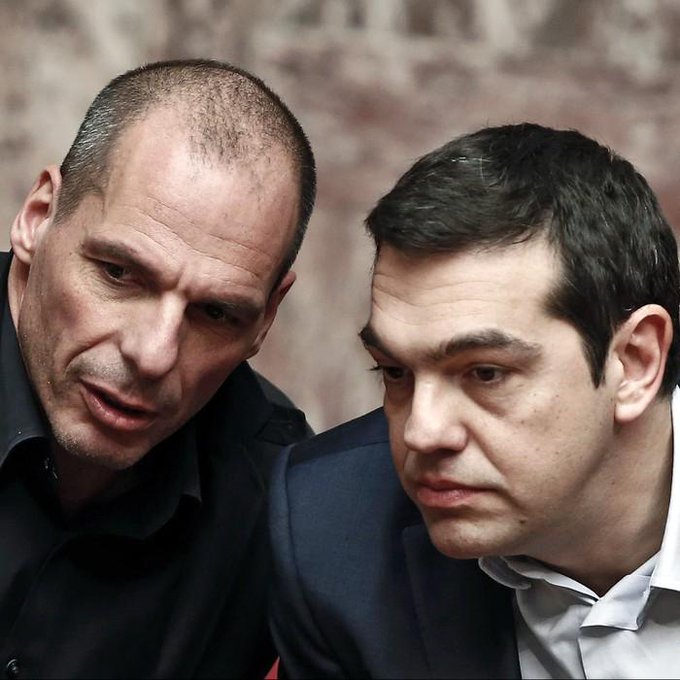 |
| 'How long are we going to play chicken?' 'I don't know, I wasn't thinking past the election.' |
Feb 21, 2015


Jan 15, 2015
The Culture of Free
There's been a lot written about "the culture of free" on the internet.
About how Napster spawned the expectation of most consumers that they can get great stuff for free online, and how newspapers and any company trying to make any profit at all have been trying to combat it ever since.
About how "if you're not paying for the product [Google, Facebook], then you are the product".
About how journalism is struggling to stay afloat, relevant and high-quality in a deluge of content-farming clickbait sites paying zero dollars for content.
I am part of the problem. I love my favourite podcasts but have so far not donated to a single one. (I tell myself I will). I use Wikipedia all the time, and I would like to keep it free of ads, but I have not contributed to their $3 fundraiser (I tell myself I will).
I have one online newspaper subscription, to Fairfax, which gives me full access to The Age and the Australian Financial Review for a very reasonable amount (which I suspend when funds are tight). I used to also have The Australian, but I let that go a couple of years ago when it became just too ridiculously right-biased even for my fairly elastic tastes.
I used to have an online subscription to Vanity Fair (jeez, a lifetime ago - who has time to read those articles now?). And I gave myself a three-month print-and-online subscription to New Scientist for my last birthday, which I plan to cancel - not because it's not excellent, but because it's expensive. I know buying a print magazine almost every week is more expensive, but an odd thing happens when you take up a subscription: you stop reading the bloody thing. Why it is I eagerly bought and read every issue at the newsagents for premium dollars for years, and now have 10 issues unopened from their plastic wrappings and the app barely accessed on my phone I just don't understand, but there it is.
I read lots of books on Kindle, and I buy a few songs from iTunes. (I know, Spotify, Pandora etc - I'll get there).
But apart from those things, I don't pay for anything I consume online. (I don't torrent movies, or try to get around paywalls - I just stick to the free stuff).
I read newspapers, Slate, Cracked, Buzzfeed, Salon, Rolling Stone, The Atlantic, Jezebel, Freakonomics, i09, Forbes, New Scientist, Meanjin, Daily Science Fiction... and anything else interesting I get from Twitter or elsewhere. All excellent content, all "free" for now.
I know it's going to get worse. Pop-up ads are getting more intrusive, especially on mobile devices - many are virtually malware. It has got to the point where you just can't finish reading a '15 celebrities who...' list without giving up in disgust. Honestly!
And yet I am part of the problem.
To be honest I'm not sure Napster is to blame, or that it even started with the internet. In my youth I loved PBS Public Radio and I was happy to hear every second song interspersed with earnest pleas for donations, and I never donated anything (I always told myself I would).
You see I always think: what if I donate and this thing doesn't survive - I've lost my money.
And even less nobly, I think: enough other people will donate, it will be OK.
And sure enough, next week's podcast contains a heartfelt 'thank you so much for contributing, you guys are great and we are so thankful!' and I can relax a little and know that my favourite podcasts will continue.
I know - I'm not proud of it.
Today I clicked a link from Twitter to this article (see pic below). You will note an extremely reasonable - nay, awesome - subscription deal offered by the Boston Globe. You get 5 free articles, or you can subscribe for 99c - for all access, forever! (or possibly for just one year, but either way, awesome).
And I thought: Let's just see how the five articles go first.

About how Napster spawned the expectation of most consumers that they can get great stuff for free online, and how newspapers and any company trying to make any profit at all have been trying to combat it ever since.
About how "if you're not paying for the product [Google, Facebook], then you are the product".
About how journalism is struggling to stay afloat, relevant and high-quality in a deluge of content-farming clickbait sites paying zero dollars for content.
I am part of the problem. I love my favourite podcasts but have so far not donated to a single one. (I tell myself I will). I use Wikipedia all the time, and I would like to keep it free of ads, but I have not contributed to their $3 fundraiser (I tell myself I will).
I have one online newspaper subscription, to Fairfax, which gives me full access to The Age and the Australian Financial Review for a very reasonable amount (which I suspend when funds are tight). I used to also have The Australian, but I let that go a couple of years ago when it became just too ridiculously right-biased even for my fairly elastic tastes.
I used to have an online subscription to Vanity Fair (jeez, a lifetime ago - who has time to read those articles now?). And I gave myself a three-month print-and-online subscription to New Scientist for my last birthday, which I plan to cancel - not because it's not excellent, but because it's expensive. I know buying a print magazine almost every week is more expensive, but an odd thing happens when you take up a subscription: you stop reading the bloody thing. Why it is I eagerly bought and read every issue at the newsagents for premium dollars for years, and now have 10 issues unopened from their plastic wrappings and the app barely accessed on my phone I just don't understand, but there it is.
I read lots of books on Kindle, and I buy a few songs from iTunes. (I know, Spotify, Pandora etc - I'll get there).
But apart from those things, I don't pay for anything I consume online. (I don't torrent movies, or try to get around paywalls - I just stick to the free stuff).
I read newspapers, Slate, Cracked, Buzzfeed, Salon, Rolling Stone, The Atlantic, Jezebel, Freakonomics, i09, Forbes, New Scientist, Meanjin, Daily Science Fiction... and anything else interesting I get from Twitter or elsewhere. All excellent content, all "free" for now.
I know it's going to get worse. Pop-up ads are getting more intrusive, especially on mobile devices - many are virtually malware. It has got to the point where you just can't finish reading a '15 celebrities who...' list without giving up in disgust. Honestly!
And yet I am part of the problem.
To be honest I'm not sure Napster is to blame, or that it even started with the internet. In my youth I loved PBS Public Radio and I was happy to hear every second song interspersed with earnest pleas for donations, and I never donated anything (I always told myself I would).
You see I always think: what if I donate and this thing doesn't survive - I've lost my money.
And even less nobly, I think: enough other people will donate, it will be OK.
And sure enough, next week's podcast contains a heartfelt 'thank you so much for contributing, you guys are great and we are so thankful!' and I can relax a little and know that my favourite podcasts will continue.
I know - I'm not proud of it.
Today I clicked a link from Twitter to this article (see pic below). You will note an extremely reasonable - nay, awesome - subscription deal offered by the Boston Globe. You get 5 free articles, or you can subscribe for 99c - for all access, forever! (or possibly for just one year, but either way, awesome).
And I thought: Let's just see how the five articles go first.
Do you pay for stuff online, donate to sites and podcasts, or freeload? Is it freeloading, when the stuff is offered ostensibly free?
Nov 20, 2014
Words for Wednesday: The Recession and the Future
It's been a while since I've done a Words for Wednesday, but this week's words inspired me, and also I can not often resist a rhyming challenge.
'Words for Wednesday' is a writing prompt held by Delores at Under the Porch Light.
Use some or all of the week's words, write a poem or a story or part of a story, and visit Delores' current week's prompt to let her know you've joined in.
This week there were two lists; I chose the rhyming one:
Here is my effort:
'Words for Wednesday' is a writing prompt held by Delores at Under the Porch Light.
Use some or all of the week's words, write a poem or a story or part of a story, and visit Delores' current week's prompt to let her know you've joined in.
This week there were two lists; I chose the rhyming one:
trepidation
stagnation
depreciation
domination
acclimatization
corroboration
The Recession and the Future
The GFC caused wide stagnation
Unemployment, depreciation
The end of the US domination
Of economic occupation
Now things are getting better, slowly
So they say, though here in lowly
Mortal world it doesn’t seem so
Money’s tight and jobs are more so
We read the news with trepidation
Stories lend corroboration
To fears and predeterminations
Nothing seems in moderation
Is it a question of familiarisation?
What’s the secret of acclimatization
To economic deprivation
And social want and dislocation?
We hope for better, kinder days
A future mapped in better ways
We wait and wonder what will follow
When today becomes tomorrow.
Jul 30, 2014
Why I bribe my kids
My favorite podcast is Freakonomics ("the hidden side of everything"). They cover topics like "Does religion make you happy?" (yes), "What do King Solomon and David Lee Roth have in common?" (use of game theory), and my personal favorite, "The upside of quitting" (let it go, let it go..!)
Last week their topic was "Why you should bribe your kids". (transcript here).
This was timely because I have just recently started paying my kids to eat vegetables.
I tend to think like an economist, so I have no problem with this. That is, I believe that (a) people respond to incentives, and (b) it is very, very difficult to get people to do things that they don't want to do, without them.
Of course, I am slightly uncomfortable with it. I would prefer to have my kids eat vegetables because I have modelled healthy eating, because I am a tough parent ("eat it or starve"), and because I have structured our lives and our menus in a way that the kids have learned naturally to enjoy their vegetables. But I have tried all of these things - some of them even consistently - and I know only that they involve a constant uphill battle for correspondingly little payoff. (See? economic thinking).
Bribery is not my only MO.
I hide vegies too. My kids love mashed potato. They only recently found out that I have always made it with half potato, half cauliflower. I have chopped up green and orange vegetables so tiny you can barely see them, and mashed them into mincemeat burgers, only to have eagle-eyed seven-year-olds screech "What's that?" after taking one bite. I have mixed too many pureed vegies into bolognaise sauce and made an unappetizing grey gloop that even I didn't want to eat.
I heard a CSIRO scientist on the radio a couple of years ago say he lets his kids pour chocolate sauce on their vegetables, because eating vegetables is that important. I've never done that (my kids have enough chocolate in their lives), but I have simmered green beans in butter and honey (delicious!) and served broccoli with honey drizzled over the top (meh).
I've coated Brussels sprouts in breadcrumbs and toasted them - or fried them. I've made fritters out of flour, vegetables and cheese that are goddamn delicious - all to fairly unenthusiastic reception.
I have kept up serving vegetables, and tried to keep them varied, and I've tried to keep mealtimes light-hearted and natural (don't want to create an eating disorder!) I've put various vegies on the table and said "You just have to eat one green thing and one yellow thing."
I've taught them how vegetables make them strong, and keep their innards working, and help them go to the toilet. I've told them stories about people who didn't eat vegies and got sick, or didn't grow. I've waxed lyrical on the satisfying crunch of a lettuce slice in a burger, or the tangy sweetness of red capsicum in a taco.
I've served up something I know they won't want, but might actually like, and said "You just have to have one bite. But if you like it, you can eat more, if you want."
And all of these things work a bit, and so I keep going with them all.
But I've had the most success yet the times when I've piled up their plates and announced: "I'm paying 50c per vegetable today", or "Three bucks to whoever eats ALL their vegetables tonight."
I am quite sure that many people will think - or comment - "Wow, when I was a kid we just ate what we were given", or "I don't offer my kids any alternative" or "If they don't eat it for dinner I give them the leftovers for breakfast". All that is great, and if these are your methods and they work, then that's great.
I too, as a kid, ate what I was given for dinner, and I didn't always like it. I can't remember if I ate all my vegetables. I probably did, or at least ate most of them. I don't remember complaining.
But times have changed and the way we run our lives and food has changed. Kids get more to eat now, and more variety, and yes, that makes healthy dinners harder.
So I'll stick to my mix of tricks: all the things mentioned above, plus bribery a couple of times a week, until the healthy habits stick.
Last week their topic was "Why you should bribe your kids". (transcript here).
This was timely because I have just recently started paying my kids to eat vegetables.
I tend to think like an economist, so I have no problem with this. That is, I believe that (a) people respond to incentives, and (b) it is very, very difficult to get people to do things that they don't want to do, without them.
Of course, I am slightly uncomfortable with it. I would prefer to have my kids eat vegetables because I have modelled healthy eating, because I am a tough parent ("eat it or starve"), and because I have structured our lives and our menus in a way that the kids have learned naturally to enjoy their vegetables. But I have tried all of these things - some of them even consistently - and I know only that they involve a constant uphill battle for correspondingly little payoff. (See? economic thinking).
Bribery is not my only MO.
I hide vegies too. My kids love mashed potato. They only recently found out that I have always made it with half potato, half cauliflower. I have chopped up green and orange vegetables so tiny you can barely see them, and mashed them into mincemeat burgers, only to have eagle-eyed seven-year-olds screech "What's that?" after taking one bite. I have mixed too many pureed vegies into bolognaise sauce and made an unappetizing grey gloop that even I didn't want to eat.
I heard a CSIRO scientist on the radio a couple of years ago say he lets his kids pour chocolate sauce on their vegetables, because eating vegetables is that important. I've never done that (my kids have enough chocolate in their lives), but I have simmered green beans in butter and honey (delicious!) and served broccoli with honey drizzled over the top (meh).
I've coated Brussels sprouts in breadcrumbs and toasted them - or fried them. I've made fritters out of flour, vegetables and cheese that are goddamn delicious - all to fairly unenthusiastic reception.
I have kept up serving vegetables, and tried to keep them varied, and I've tried to keep mealtimes light-hearted and natural (don't want to create an eating disorder!) I've put various vegies on the table and said "You just have to eat one green thing and one yellow thing."
I've taught them how vegetables make them strong, and keep their innards working, and help them go to the toilet. I've told them stories about people who didn't eat vegies and got sick, or didn't grow. I've waxed lyrical on the satisfying crunch of a lettuce slice in a burger, or the tangy sweetness of red capsicum in a taco.
I've served up something I know they won't want, but might actually like, and said "You just have to have one bite. But if you like it, you can eat more, if you want."
And all of these things work a bit, and so I keep going with them all.
But I've had the most success yet the times when I've piled up their plates and announced: "I'm paying 50c per vegetable today", or "Three bucks to whoever eats ALL their vegetables tonight."
I am quite sure that many people will think - or comment - "Wow, when I was a kid we just ate what we were given", or "I don't offer my kids any alternative" or "If they don't eat it for dinner I give them the leftovers for breakfast". All that is great, and if these are your methods and they work, then that's great.
I too, as a kid, ate what I was given for dinner, and I didn't always like it. I can't remember if I ate all my vegetables. I probably did, or at least ate most of them. I don't remember complaining.
But times have changed and the way we run our lives and food has changed. Kids get more to eat now, and more variety, and yes, that makes healthy dinners harder.
So I'll stick to my mix of tricks: all the things mentioned above, plus bribery a couple of times a week, until the healthy habits stick.
Do you / did you bribe your kids?
 |
| Mmmmmm, vegetables... |
Jul 8, 2014
Trickle-Down Economics
The trickle-down theory, also known as supply-side theory, is the idea - largely hated but still beloved by policy makers - that wealth 'trickles down' from the top to other levels of society.
The theory goes that if you provide tax cuts and investment incentives to business and the wealthy, business and investment increase and thereby provide economic benefit to everyone else.
There has always been opposition to this theory, and it has always been up for parody. Since the GFC, dissent has grown with the Occupy Wall Street movement and its powerful theme: "We are the 99%" . Current bestseller 'Capital in the Twenty-First Century' posits that instead of trickling down, wealth tends to accumulate at the top and stay there, forcing an ever-growing gap between rich and poor that threatens political and social stability.
Policy makers have a hard job these days. The world is more difficult to run because we all know now how complex it is. The digital world (24-hour news, social media, democratised commentary) doesn't give politicians a break. The Great Recession continues and shows no real sign of ending. And following the ambiguous results of stimulus programs since 2008, stimulus is out and economic tough love is back in.
We know we can't go back to high levels of taxation and over-regulated economies. Having lived in a stagnant, isolated economy (New Zealand pre-deregulation) I remember it doesn't work. But I also lived in an economy going through the throes of deregulation (New Zealand under 'Rogernomics') and it was painful to see the impacts: people suffering the blows of sudden, wrenching change and the government seemingly heartless in response.
So the market can't be left to run unfettered. Some level of 'tax-and-spend' is necessary to regulate, ensure a modicum of fairness, and pay for necessary infrastructure and services.
The trickle-down effect may work a little, but it's not very effective and it's not a solution in itself for managing an economy.
Here's my view of the trickle-down effect:

The theory goes that if you provide tax cuts and investment incentives to business and the wealthy, business and investment increase and thereby provide economic benefit to everyone else.
There has always been opposition to this theory, and it has always been up for parody. Since the GFC, dissent has grown with the Occupy Wall Street movement and its powerful theme: "We are the 99%" . Current bestseller 'Capital in the Twenty-First Century' posits that instead of trickling down, wealth tends to accumulate at the top and stay there, forcing an ever-growing gap between rich and poor that threatens political and social stability.
Policy makers have a hard job these days. The world is more difficult to run because we all know now how complex it is. The digital world (24-hour news, social media, democratised commentary) doesn't give politicians a break. The Great Recession continues and shows no real sign of ending. And following the ambiguous results of stimulus programs since 2008, stimulus is out and economic tough love is back in.
We know we can't go back to high levels of taxation and over-regulated economies. Having lived in a stagnant, isolated economy (New Zealand pre-deregulation) I remember it doesn't work. But I also lived in an economy going through the throes of deregulation (New Zealand under 'Rogernomics') and it was painful to see the impacts: people suffering the blows of sudden, wrenching change and the government seemingly heartless in response.
So the market can't be left to run unfettered. Some level of 'tax-and-spend' is necessary to regulate, ensure a modicum of fairness, and pay for necessary infrastructure and services.
The trickle-down effect may work a little, but it's not very effective and it's not a solution in itself for managing an economy.
Here's my view of the trickle-down effect:
May 31, 2014
Agents and Agencies
I've thought a lot over the last few years about how our world is organised, and how it has changed. Namely, that everyone outsources. And this is ever-increasing, so that you get more and more layers to everything, and everyone gets more specialised.
The New York Times tweeted this yesterday:
Well, why not the fight against terrorism? Everything else specialises, and farms out what it is inefficient to do itself. It's the story of our age: everything uses third parties, agencies, proxies, aggregators.
I work in stockbroking operations. Since 2008 the stock market has been DEAD. For the last 3 years everyone has expected the coming year to pick up. Now we're saying 2015. Surely 2015? It has to pick up sometime!
In the meantime, as conventional brokerage has been DEAD, companies have been scrambling. The growth area (well, "growth" is a bit much - let's say "segment everyone is scrambling to") is to form small - tiny - advisory firms and build up a list of clients, and pay bigger brokers to do your trade execution. These days not only is the cost of running a brokerage firm prohibitive, but the compliance onus is very high. Only medium-to-large firms can do it now. Everyone else has given it up and is operating these tiny, ever-morphing advisory groups. Many of those groups do work for other advisory groups, so for example, Broker A has client Firm B which has direct clients but also has a client Firm C which has its own clients, one of which is Firm D..... So you end up with very diffuse, multi-layered business and client structures.
Another growth area is portfolio "wrap" services and reporting services. These are aggregators, who take in data feeds from brokers and custodians and create custom reporting, data mining or portfolio management for clients. They might do this under their own banner, or offer "white labelling" so that reports are branded for another firm who passes them on to its clients.
Among brokers, even larger players are using each other to perform some functions, or execute for some sectors of their business. No one is trying to do everything anymore.
Everywhere the same thing is happening. Insurance: a million different small firms, underwitten by the old large ones that used to do it all. And various aggregator businesses specialising in filtering options and helping you choose. Utilities: as governments have privatised services like electricity, we now have multiple providers, but it goes further: the electricity provider uses a billing service to manage its billing, and on-sells debts to a debt collection agency. I would not be surprised to learn that beyond each of these there are a further two or three "layers" or agents, responsible for different portions of the work.

Governments privatise services when they become too costly to run, which is essentially all of them in these days of low-taxing low-spending governments. Companies take them over and quickly work out they are not profitable, so the companies become more efficient and specialised and farm out or sell off the bits they can't afford to do to someone else.
Is it good? Is it bad? These questions were asked more often in the previous decade. We're all used to it now (more or less), and on balance I think it's good. It makes commerce vibrant and varied, it keeps things nimble and fosters growth and change. And it spreads risk and limits damage: if one part goes wrong it doesn't affect the whole; another small part springs up to take its place. What I can't figure out is if, holistically speaking, measuring the whole system, it is more efficient or not. I'm sure that it is, but it's hard to quantify. But regardless, whether it is or not, it is now such a fact of business and life that it's just the way it is. We could no more unwind it than we could un-layer an onion.
The New York Times tweeted this yesterday:
U.S. Strategy to Fight Terrorism Increasingly Uses Proxies http://t.co/2RB35w5XdL
— The New York Times (@nytimes) May 30, 2014
Well, why not the fight against terrorism? Everything else specialises, and farms out what it is inefficient to do itself. It's the story of our age: everything uses third parties, agencies, proxies, aggregators.
I work in stockbroking operations. Since 2008 the stock market has been DEAD. For the last 3 years everyone has expected the coming year to pick up. Now we're saying 2015. Surely 2015? It has to pick up sometime!
In the meantime, as conventional brokerage has been DEAD, companies have been scrambling. The growth area (well, "growth" is a bit much - let's say "segment everyone is scrambling to") is to form small - tiny - advisory firms and build up a list of clients, and pay bigger brokers to do your trade execution. These days not only is the cost of running a brokerage firm prohibitive, but the compliance onus is very high. Only medium-to-large firms can do it now. Everyone else has given it up and is operating these tiny, ever-morphing advisory groups. Many of those groups do work for other advisory groups, so for example, Broker A has client Firm B which has direct clients but also has a client Firm C which has its own clients, one of which is Firm D..... So you end up with very diffuse, multi-layered business and client structures.
Another growth area is portfolio "wrap" services and reporting services. These are aggregators, who take in data feeds from brokers and custodians and create custom reporting, data mining or portfolio management for clients. They might do this under their own banner, or offer "white labelling" so that reports are branded for another firm who passes them on to its clients.
Among brokers, even larger players are using each other to perform some functions, or execute for some sectors of their business. No one is trying to do everything anymore.
Everywhere the same thing is happening. Insurance: a million different small firms, underwitten by the old large ones that used to do it all. And various aggregator businesses specialising in filtering options and helping you choose. Utilities: as governments have privatised services like electricity, we now have multiple providers, but it goes further: the electricity provider uses a billing service to manage its billing, and on-sells debts to a debt collection agency. I would not be surprised to learn that beyond each of these there are a further two or three "layers" or agents, responsible for different portions of the work.
Governments privatise services when they become too costly to run, which is essentially all of them in these days of low-taxing low-spending governments. Companies take them over and quickly work out they are not profitable, so the companies become more efficient and specialised and farm out or sell off the bits they can't afford to do to someone else.
Is it good? Is it bad? These questions were asked more often in the previous decade. We're all used to it now (more or less), and on balance I think it's good. It makes commerce vibrant and varied, it keeps things nimble and fosters growth and change. And it spreads risk and limits damage: if one part goes wrong it doesn't affect the whole; another small part springs up to take its place. What I can't figure out is if, holistically speaking, measuring the whole system, it is more efficient or not. I'm sure that it is, but it's hard to quantify. But regardless, whether it is or not, it is now such a fact of business and life that it's just the way it is. We could no more unwind it than we could un-layer an onion.
May 17, 2014
Budget Bugbears
When the federal budget was handed down this week my initial reaction was less anger than I have now.
No, there is not actually a "budget emergency", and the constant spam about Labor's "spending" is unfair given we are actually talking about economic stimulus following the GFC - but, we do have a big deficit and it has to be fixed, and that means cuts to things we don't want to cut.
So, cuts to the public service? Expected. Not good - in some cases no doubt, terrible - but expected.
Return of the fuel excise? Not that terrible, a sensible measure.
Cuts to renewable energy programs? Totally expected given we all know where this government stands on that.
Cuts to family tax benefits? Both sides have had this on the agenda and the cuts were less than expected.
The income tax levy on higher-income earners: surprising for a coalition government, though of course it's not permanent.
But these things make me angry, firstly because they're wrong, but perhaps even more than that, because they are lies - they are nothing to do with fixing a "budget emergency", but are about ideology:
No, there is not actually a "budget emergency", and the constant spam about Labor's "spending" is unfair given we are actually talking about economic stimulus following the GFC - but, we do have a big deficit and it has to be fixed, and that means cuts to things we don't want to cut.
So, cuts to the public service? Expected. Not good - in some cases no doubt, terrible - but expected.
Return of the fuel excise? Not that terrible, a sensible measure.
Cuts to renewable energy programs? Totally expected given we all know where this government stands on that.
Cuts to family tax benefits? Both sides have had this on the agenda and the cuts were less than expected.
The income tax levy on higher-income earners: surprising for a coalition government, though of course it's not permanent.
But these things make me angry, firstly because they're wrong, but perhaps even more than that, because they are lies - they are nothing to do with fixing a "budget emergency", but are about ideology:
- $20 billion medical research fund. Medical research and science are absolutely great and all, but this is wrong for two reasons. Firstly, if we are truly in the grip of a dire budget emergency and all sorts of cuts have to be made, why commit to this now? Secondly, it is funded by huge cuts to public health funding, and the outrageous GP "co-payment". Somehow I feel like this has Tony Abbott's health freakery stamped all over it. I don't know how, but you know, "it's the vibe of the thing".
- $7 GP "co-payment" - very harsh, will have unintended (but entirely predictable) consequences, and it goes entirely against what Medicare is. Plus, it is nothing to do with fixing finances. $2 will go to the doctors (probably just to cover the admin required) and $5 to fund the medical research future fund. It is wrong, and unfair.
- Cuts to welfare generally. Abbott says we have to "break the welfare mindset". Well, there isn't one. Sure, there was in the past, from some people. But welfare bludging hasn't been a thing for years. People receiving disability pensions, Newstart and the like are already on the breadline. And also, why does "everyone" have to "chip in" to fix the deficit? Spread the pain, sure, but spare the very bottom. And yes, you could take a bit more from the top without hobbling business and waging class warfare.
- Funding increased for school chaplaincy program (despite growing public resistance to it) with removal of the current option for schools to use the funding to appoint a secular student welfare officer. It's religion or nothing. Sorry, but are we, or are we not, a secular state? And how can increased funding be found for school chaplains when school funding itself is being cut and we are in a budget emergency? Because the program is less about student welfare than proselytizing, that's why.
Look, for most of us it's not the end of the world. Times are tough economically, and things need to be done. This budget is not a total horror. I get sick of the silliness that is pervading public debate at the moment - that Abbott is evil, that Labor did no wrong whatsoever, that the government is sure to lose the next election (two years out!) based on its current unpopularity. I'm a measured person, and the truth for me is always in the middle.
But there are things that many of us are unhappy with, and I'll leave the last word to Mike Carlton at the SMH, who wrote this week:
It is a delicious irony that Abbott has destroyed the faith the voters placed in him. Endlessly blackguarding Julia Gillard for her broken carbon tax promise and trumpeting himself as a paragon of probity, he raised the bar.
On Tuesday he fell beneath it, face down in the mud, and will never be trusted again.
Apr 30, 2014
Budget Leaks
(For my American readers, Labor = Democrats, Liberals = Republicans)
God, I hate the week before Budget Day. All those orchestrated "leaks", and the government "refusing to rule out" the "rumored" cuts. All a strategy to drip-feed the painful bits to us so that no one is too shocked on the day and the government can hit back on criticism with messages they have practiced.
Aaargh - just give us the damn budget already!
And the whole malarkey both sides of politics play, known by everyone, played by everyone, annoying everyone on all sides equally:
- Current government [whoever it is at the time]: "Your side stuffed everything up; we're trying to fix it, but we're still dealing with the legacy of what you did"
- Opposition government [whoever it is at the time]: "How come when we tried to do [thing] you opposed it and now you're doing [same thing]?"
- If the Labor government attempts to introduce means testing for benefits, Liberals call this "class warfare".
- If the Liberal government attempts to introduce means testing for benefits, it is called "being responsible".
Liberal and Labor are different. They have different philosophies and they govern differently. But the people in charge of the economy on both sides are not too dissimilar in their basic economic beliefs, these days. Everyone knows and agrees that economies have to be lightly managed and vibrant, that business and entrepreneurship have to be encouraged, that growth is necessary, that everyone is better off when interest rates are low and business is booming.
Everyone has been in broad agreement for some time that we have a deficit and it has to be brought under control.
Everyone has been in broad agreement for some time that the tax system is too convoluted, there are too many transfers, and "middle class welfare" has got a little bit out of control.
Labor didn't ignore the deficit. They were unable to do much to fix it because (a) GFC required massive stimulus requirement, (b) their every move was thwarted by a hung parliament, and (c) internal in-fighting.
Liberals accuse Labor of reckless spending and mismanaging the economy. Labor for some reason (maybe because it does have a tendency to spend?) is terrible at refuting this argument, even when it is wrong and grossly unfair.
Does no one remember 2008? After the GFC it was the mantra of every central bank and economist in the world: Spend! Spend! Stimulate the economy!
Unfortunately, Labor happened to be in power when that happened. Hence the horrific home insulation debacle (in which three contractors died), and the ridiculous "Building the Education Revolution" which has left every school everywhere with a state of the art building awkwardly placed and of indeterminate functionality.
(Labor is its own worst enemy most of the time. Speaking of class warfare: Comrades, can we please agree not to use words like "revolution" perhaps?)
So Labor spent all that money because CRISIS and STIMULUS and GFC. And Liberal would have done the same thing, though no doubt would have spent the money differently.
One does leave oneself open to charges of "mismanaging the economy" when one's remit is based around social equity instead of trickle-down economics, I suppose.
So back to the Budget.
What do we have so far?
- Deficit levy: a tax for four years on a scale based on taxable income, to pay off the national deficit. This one won't hit me with my current pay packet, so I'm going to mark it REASONABLE. We are in debt after all, and everyone (earning more than me) has to chip in! (Heh heh...)
- Aged Pension: possible raising of the qualifying age from 65 to 70 (though more seems more likely now in a future budget). Has been talked about for some time, an evil we all knew was coming at some stage. Everyone my generation and younger expects to be working until they're eighty anyway. Very bad for people approaching retirement age now, and for workers like my husband who do back-breaking physical jobs. I'm calling this one HARSH BUT INEVITABLE.
- possible cuts to "middle class welfare" such as Family Tax Benefit, Schoolkids Bonus, Carbon Tax Offset, Childcare Rebate etc. Speaking personally, my family only just became eligible for these and now we may lose them. DAMN.
- possible cuts to REAL welfare, such as Newstart, single parent payments, carers' pensions, etc. This is BAD. These benefits ceased being any kind of a loafer's gravy train years ago, and their recipients are on the poverty line. These are people who really need that support, and the payments go right back into the economy after all - not too many of these people socking their wealth away or sending it offshore.
- Medicare co-payment: $6 to be paid for bulk billed doctor visits. WRONG. Undermines everything about what Medicare is and opens the door to effectively ending it. (Americans, imagine the OPPOSITE of your fears about Obamacare!). Instead of doing that, governments should make bulk billing means-tested.
- possible removal of private health insurance rebate: BAD. The rebate exists to encourage people to have private health insurance and reduce drain on the public purse for health. I guess it is debatable to what degree it actually achieves this though. Still, you remove this, you will see even more people jettisoning their private health cover, which is bad news for public health costs.
- no tax cuts this time round: quite right too. Tax cuts are a necessity to avoid bracket creep, but there's no place for them this time round. GOOD
- paid parental leave scheme: Do you know, I've come round a bit to this one. On the face of it it sounds a bit outrageous, but I have a feeling that it's one of those things that five years down the track I'll be embarrassed I didn't support. And it will mostly be funded by business, so it isn't that expensive to normal taxpayers. And women should be supported to take adequate maternity leave and to return to work. So that's all good. But if heavy cuts are going to be made to pensions, carers' pensions, the national disability insurance scheme and welfare payments, then I have to say the previous high threshold on this one was looking a bit on the nose, so I had pegged this one until this morning as DICEY. But now it's been announced that the means-test threshold has been reduced to $100,000, which is better. Higher-paid women are most likely being given this by their employers anyway, and the main beneficiaries of this scheme will be lower-paid women, which everyone seems to forget. So this is now OKAY.
What do you think about the upcoming budget?
Subscribe to:
Comments (Atom)
LinkWithin
