Mar 31, 2013

Personal Choice and Feminism

How do you see feminism? Is it the struggle against inequality, the right to control your body or the right to personal choice? Is it all of these?

I think I agree with Helen Razer that feminism is, in a nutshell, "the struggle against masculinsed violence and feminised poverty". 


I'm all for personal choice, but I don't really agree with those who say feminism is "all about choice".


I could choose to be a surrendered wife, and that would make me a proponent of personal choice, but it would not make me a feminist.


Earlier this month Jessica Rowe wrote a column that opened with "I use Botox and I'm a feminist." I like Jessica Rowe, I have no problem with her Botox use, and I am totally on board with the fact that those who work in the limelight face harsher pressure than the rest of us to look good. Good on her for her honesty - it's great when women in the public eye are honest about these things (not that they have to tell us, but it would be nice if they didn't lie about it). I believe Jessica Rowe when she says she's a feminist. But defending Botox by saying "my brand of feminism is all about personal choice" doesn't gel with me. Defend it as a personal choice, a freedom, a right - even a necessity for continuing a career in the spotlight. That's all excellent. But feminism, it is not.


Life is hard. Life is demanding and pretty relentless and most of us cannot be Germaine Greer all our lives and all the time. Even Germaine Greer doesn't manage it.  We are, most of us, feminists at heart, but we all have our embarrassing secrets, our contradictions and our exceptions - things we believe or want or do even though we know they're not, you know, feminist.


What about choosing to give up paid work, to be home for your children full-time?


That's a harder one. There are those who say you can't be a feminist and not work; there are others who say giving up paid work (and the control and autonomy that it makes possible) is not wrong but is misguided and self-harming; there are others who say it is pro-children and pro-family, and most people agree with that but argue over what degree it is pro-woman.


For most women who give up paid work (whether for awhile or forever), it is a compromise, like most things in life.  For all but a tiny few women it's not about "avoiding work" or wanting to be "looked after". It's because it's the easiest or most rational choice in an insane juggling act, or a decision made trying to do the best thing for their children. 


Women advocate for children. It's what they do, all day, every day.  Every mother I know advocates for her children, in every moment and every day, whether she is with them or not, whether she is dealing with a problem or leaving them free to play, whether she is talking about them with her partner, or to a doctor, their school, her boss, or her blog.


I am irritated when I read the phrase "women and children" in news articles on war casualties and disasters. "Women and children" - no. Try "innocent civilians, including children". Or just "children".  WOMEN are no more special, valuable, innocent or precious than men. WOMEN can and do fight wars, make bombs, make heroic or horrible decisions and take lives. WOMEN are not children.


And yet... At the same time I feel a contradictory pride in the phrase "women and children" even while it irritates me. Women partner with children. Women look after children. Women advocate for and protect children. A woman partners herself with her children in her decision to take her husband's last name, in her decision to marry, in her decision to give up paid work. A woman championing her children and making them her focus during her race in this masculine, competitive world, is pro-woman and pro-children, and couldn't that be called feminist?


But what of the woman who wants to be something else? Who chafes at the restrictions of "the pram in the hall" and while she loves her children, feels desperate and hobbled because of them? Is not her struggle a feminist struggle, the ongoing fight against the culture which uses biology to perpetuate "feminized poverty"?


The answer to both has to be yes - and then doesn't this get us back, full-circle, to the argument I reject, that "feminism is all about personal choice"?


Image via FreeDigitalPhotos.net


I don't know, but my head is hurting, and I have thought about these things for years now and my thinking is no less muddled. I detest the idea that there is a "right" way to be feminist, and I hate the idea that women are put off by feminism because of esoteric academic tussles and fights over "personal choice". Honestly, no one needs a tertiary degree to understand feminism, and the bits you need a degree for are just words. You might not be able to discuss the ideas, but you would if they were worded differently, because you've living them or you've seen them on the news and you've already thought about them.


So there you are and there I am - as muddled and contradictory a feminist as a former radical making fun of a female prime minister for her choice of clothing. 


Mar 30, 2013

Longer than I thought

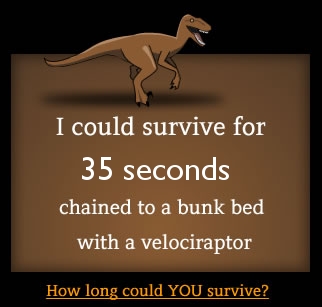
This is longer than I thought I would last - I'm a bit impressed with myself.


How long could you survive chained to a bunk bed with a velociraptor?
Created by Oatmeal

Mar 18, 2013

Photos: Marvellous Melbourne


                      Hosier Lane


Luna Park


                                                                        Skylines


St Kilda Road


Reflections on a building


From the rooftop of the old Herald Sun building


Carols by Candlelight, Jells Park

City scenes


Autographed photos in a hole-in-the-wall cafe:
Nicolas Cage and Chopper Read

Arts Centre Sunday Market

Princes Bridge

Federation Square


Flinders Street Station

Shot Tower


Art Gallery

the 'water wall' at the art gallery (and the top of
my daughter's head)


I Heart You Melbourne :-)

Mar 13, 2013

When Language Evolves Wrong

Language evolves. Pedants, get over it! I smirk or eye-roll at those who get uppity over things like these:

  • Slang / teenagers speaking like US movies
  • Foreign-born shopkeepers or business owners with more pressing concerns than written grammar, putting apostrophes in the wrong place on window signs  
  • 'Over' used with a number instead of 'greater than'.
  • Adjectives used as adverbs - "when language evolves wrong" [ironic use, see], "when things go bad" ["badly" is fastly disappearing]
  • "their" used as a gender-neutral possessive pronoun instead of the cumbersome "his or her"
  • Split infinitives - surely no-one cares about this anymore
  • Fragmentary sentences and sentences that start with And. Move on. Literature did, some time ago.


But we all have our language pet hates. And though I thought I was pretty cool over this stuff, once I started listing them I found I had quite a lot.

So here are mine:

  • "less" used with plurals, instead of "fewer". I know - this battle's long lost, I need to GET OVER IT
  • the incorrect form of a word (noun/adverb/verb) used where there are two forms - e.g. "the account has been setup" [set up]; "please login" [log in]; "Big savings everyday" [it should be "every day" - or else make it an adjective, as in "everyday savings"]
  • "factoid" used for "fact". A "factoid" is not an interesting tidbit of information, but a supposed-fact or a folk-belief presented as fact, such as "Eskimos have 200 words for snow"
  • incorrect word formations caused by people forgetting there is an actual other word for what they're trying to say - business English is a big offender here. My biggest problem at the moment is "in agreeance" instead of "in agreement"
  • malapropisms that become widely used (hello again, business English): "Let me take a new tact" (tack); "this is a one-of situation" [one-off]; "they are one in the same" [one and the same]
  • parentheses, m-dashes or semi-colons used incorrectly - such as when each part of a sentence divided by a semi-colon isn't related or doesn't form a grammatical sentence, or, as is becoming VERY common now (tsk tsk), when the bit in parentheses can't be taken away without destroying the grammar of the sentence around it (in which case it shouldn't be in parentheses)
  • lists where one of the items doesn't match the verb in the list header. You know the sort of thing: "All reports must be: (1) typed, (2) not have errors."  Or where there are not enough "and"s in the sentence because the list ends with a pair that needs its own "and" - e.g.: "ribbons, buttons, needles, odds and ends" 
  • too many commas, or commas in the wrong place (Though I am all for the Oxford comma, and other commas before "and" where they increase readability)

Then there are the classics: 
  • "infer" used for "imply"; "disinterested" used for "uninterested"  - though I am starting to care less about those (there's that evolution happening)
  • your/you're; there/their/they're
  • its/it's (I can see this one evolving into a single all-purpose "its" right before my eyes)
  • me/I, me/myself (business English, I'm looking at you again, with your attempt-at-formal "please contact myself at...")
And the ugly portmanteaus - 
  • the ones that are too cute, like "staycation" 
  • the ones that try too hard or don't rhyme with the original word, like "mansplain" (I HATE that one). 
But unlike the anti-portmanteau commentators I've read, I quite like "chillax" and "recessionista". They are inventive and fun and they work. (Says me anyway).


There are also a few phrases I hate - just HATE. These are:
  • "It was on for young and old." I've always hated it - so weird and old-fashioned and strange. 
  • "Flat chat" for "busy". "Flat tack" is OK.
  • "First in best dressed." This one has come about within my lifetime and I'm not happy with it. When I was a kid, only the root phrase was in use, which was "first come, first served" or "first in first served". I may be wrong but I have a dim memory that "first in best dressed" came about through application to wardrobe-related-only situations as a play on "first in first served". So that was cool and all, but then the specific phrase supplanted the general phrase*, and now the new phrase makes no sense.
(*Let it be known I have no issue with this phenomenon in itself. I am quite happy with "walk the talk" which has evolved from "He can talk the talk, but can he walk the walk?" - though thinking about it, it's a shame to have lost that phrase. It was too long to survive I guess.)


But I am utterly relaxed on these:
  • incorrect usages of over/more than/greater than [because I personally get this wrong a lot - therefore, not important]
  • use/usage [meh - both can be correct, 'usage' is not always wrong]
  • the American expression "I could care less" for "I couldn't care less" [I could care less about it]
  • replying "I'm good" to "How are you?", instead of "I'm well" [I use both]
  • "is" or "are" for implied-plural nouns - e.g., "my bank is profitable" or "my bank are not passing on the Reserve Bank interest rate cut". Either is correct (the grammar, not the situation, boom-tish).

On the other hand, I find really odd and jarring that American grammar of using "would" instead of "had" for the past or conditional perfect: as in, "I wish you would have told me" instead of "I wish you had told me", or "if I would've known" instead of "if I had known".  That's annoying.


Oh, but have I mentioned that I also hate it when people correct other people's grammar, especially on social media?  It's snobbish, cheap, and rude. (Grit your teeth and write a blog post instead).

Finally, if I have made grammatical mistakes in this post: this means that you are a pedant and language evolves and GET OVER IT.   :-)


What do you hate?
What could[n't] you care less about?


Mar 12, 2013

My Daughter: Diplomat, Wordsmith, Troll


My daughter M has three notable qualities: natural empathy and diplomacy, love of new words, and… a worryingly skillful facility for lying, or as she calls it “joking”. (Don’t worry, we are tackling this on-going).

This morning she brought all three to bear - the little minx.

To set the scene, it is stinking hot in Melbourne for the, like, 109th day in a row or something record-making. We can't remember what it was like before this heat anymore. We wash clothes and hair daily, fill up the little wading pool twice a day for the dog, do the minimum of housework because just moving around induces sweating and fatigue. This has become our world and we accept it. I glumly recall my earlier dismissal of climate change and relegate it to an older, more innocent time... 

Anyway - it's hot. I need cool and comfy stuff to wear because I won't be in an air-conditioned office today but at the kids' school for a couple of hours. After hemming and hawing a little, I pull out a pretty, floaty sleeveless top I usually wear with a pretty, floaty chiffon jacket over the top, and decide to wear it without the jacket.

Me: Bugger it, I’m going sleeveless. (Puts on top; ignores arms in mirror; gets on with morning stuff). 
Me, last minute before heading out the door to the school: Discards sleeveless top, puts on top with sleeves. 
M: Mum, you changed your top. 
Me: Yes, sweetie, I did. Ready to go? (Attempts to shepherd kids out door). 
M: Why did you change it? 
Me: (flounders for “correct” answer, gives up, goes for accurate one): “Uh, because my arms are too fat for it.” 
M: (earnest, solicitous voice) Well I think it looked lovely on you, Mum. 
Me:  Ah, thank you honey! 
M: You looked beautiful. In fact, you actually looked spectacular in it. 
Me: Oh?! 
M: (over her shoulder, out the corner of her mouth): I don’t always mean it, but at least I say it.

Gee, thanks, love.


Mar 7, 2013

The Second Amendment and Cultural Change

Americans should persist with gun control efforts. They should not give up just because it seems impossible now. Cultural change takes 20-30 years, possibly more.


Here is the Second Amendment to the Constitution of the United States of America:

"A well regulated militia being necessary to the security of a free state, the right of the people to keep and bear arms shall not be infringed."

The impact of poorly designed legislation


The rest of the world reads this and has two thoughts:

  1. That's nuts. However, if you insist on this right, then:
  2. "well regulated" - means there's room for gun control

Within the US, there has been debate on the interpretation of the Second Amendment since soon after its ratification, with argument over the meanings of "well-regulated", "militia", "keep and bear arms" and "infringed", as well as varying interpretations of the intention of the amendment based on wording, sentence structure and the meanings of the words in 1791.  There is disagreement on whether the amendment is about ensuring the security of the state, protecting an absolute right of the individual, or protecting a limited right of the individual.

As well as that to contend with, there is the anger and bellicosity in public responses to any attempt to sell gun control in America - like this one.

There is the whole huge weight of history of gun ownership and the right to bear arms in America, which we don't have in Australia.


But, cultural change is possible.


It seems trite, and I hope it is not an offensive comparison, but look at the efforts in Australia over the last three decades to change attitudes to drink driving. In the 1970's in Australia we thought it was our constitutional right (if we had believed in such things) to drink ourselves into a stupor and drive home every Friday and Saturday night.

My own family history feels typical. When I was a kid in the 70s our family get-togethers were raucous drunken affairs sometimes ending in tearful or angry confrontations between aunts and uncles about whispered events that we didn't understand. Everyone drank and smoked and swore and was racist, and  in short it was a totally different world to how we all live today.  It took a long time for attitudes to drinking to change in Australia. It is still underway. But things did change. In general attitudes and behaviour now, we're a long, long way from 1975. Even my family came round!

Cultural change is possible. It is slow, and it takes a couple of generations, and how much is due to government intervention such as the TAC ads and how much is due to the slow pull of cultural history, it's hard to say. But it does happen.


So here's what you have to do in America when trying to tackle the Second Amendment:

Photo released by The White House on 2 Feb


At the White House website, while trying to search for this photo, I found that entering 'Obama' and 'shooting' into the search engine produced pages of Obama's public addresses in response to shootings.  So many it's shocking.  Slate online magazine is tracking the number of fatal shootings in the US since Newtown, and it is distressing how fast that number keeps growing (1,903 as at 14 February; 2,496 as at 1 March).

Ronald Reagan was in favour of gun control. John Howard is in favour of gun control. The majority of Americans are in favour of some kind of gun control. So surely, it is possible.

Here is the White House's plan for reducing gun violence. It works within the weight of history, allowing the right of individuals to bear arms and not attempting to change the Second Amendment (God forbid!). It attempts to tackle some of the issues with steps that probably should be in place anyway.

It's a good start.


Good luck, America. I love you, so I wish you every success in tackling this huge, critical problem.

'Need Change?' by Maggie Smith
via FreeDigitalPhotos.net


Feb 22, 2013

Science and Religion

Science and religion. 'And' - not 'versus'. No need.

As Julian Burnside tweeted this week:


I am an atheist, and I LOVE science. But I am not anti-religion. Religion is part of who we are as humans, and it serves multiple purposes. Religious people are probably on the whole happier, and more comforted. And we all, somewhere, retain a little bit of religious sentiment, hope or belief, even if we consciously reject it.

My kids were baptized Greek Orthodox, but we don't go to church. They opt in to religious instruction in school, though I would prefer it were not offered. I don't send them to learn ethics or how to be a good person, because you don't need religion for that. I send them because it's a huge part of human culture and society, and because religion gave me some comfort as a child. (Actually I took A out last year, because she hated it. M loves it. A wants to try again this year because her friends go, so we'll see how it goes. I've made it clear she doesn't have to go).

I answer my kids' questions about God and religion honestly (more honestly than I answer their questions about Santa).

Last week my kids learned the truth about the tooth fairy. This year I expect they'll figure out the truth about the Easter Bunny and Santa. But the truth about God and religion is not an easy one and one they will decide for themselves along the way.


Like the books on this trestle table, why can't we all just get along?


Feb 20, 2013

Hard Questions

Here are some questions my kids have asked me. I don't know all the answers - do you?


"Why don't dogs and cats get nose bleeds?"

"Which is worse: fire in your bottom or spikes sticking in your bottom?"

"Where did lice come from?"

"Who's stronger, God or Santa?"

"Why aren't dragonflies purple?"

"How come [...] downloads movies which you shouldn't do but she's a good person?"

"What's more important, a volcano or your kids?"  [huh?]

"How come dogs don't have to clean their teeth?"  [actually, ours should]

"How come you NEVER let us do anything fun!"  [huh? how did that sneak in there!]


What are some good questions you've had from kids?


Feb 19, 2013

Sponsored Posts, Disclosure and Professionalism

Disclosure: This is not a sponsored post, however it is possible that jumping on this bandwagon may bring me increased page views, which I accept is a benefit.*

If you are not a blogger, or you have been reading about this elsewhere, you may roll your eyes and click away at this point, because this may bore you silly. [Alert! Blog post about blogging follows!]

Bloggers in Australia have copped some flak recently about sponsored posts. The arguments can be summarized as:

  • bloggers are not always disclosing when they have received a product which they blog about
  • bloggers are grasping and selfish, want stuff for free and expect to be paid for crapping on about their life and kids
  • companies attempting to engage with bloggers are disrespectful and clumsy and expect free advertising from bloggers
  • bloggers are already doing the right thing but readers are overly cynical/suspicious
  • sponsored posts should be disclosed at the top of the post
  • sponsored posts can be disclosed within the post or at the bottom 
  • readers don't like sponsored posts and will click away if they see a 'sponsored post' disclosure at the top of the post
  • readers don't like to be ambushed at the end after reading a post they thought was 'real', only to find it promotes a product or business
  • bloggers are no longer blogging from the heart; there are too many sponsored posts and giveaways
  • the brand-meets-blog PR outfits are doing a lousy job fitting brands to blogs 
  • 'sponsored' means you were paid money; gifts are not sponsorship
  • money or gifts are all benefits and should be declared equally
  • supporting a business you love is not a sponsored post
  • bloggers' disclaimers that "my opinions are all mine" are meaningless because you never see a negative product review on a personal blog

Bloggers are vexed by this issue because they want to do the right thing, want (and have the right to) earn money from their blogs, and want to retain the heart and soul and authenticity in their blogs at the same time.


image by Vlado via FreeDigitalPhotos.net


Here's my opinion, in a nutshell:

I think distinguishing between cash payment and gifts is pointless. We all know that advertising and PR take many forms, and that if a business gives you a gift or gives (or lends) you a product for review, they are hoping for a return. That return may be a glowing blog post or it may be a good relationship or increased goodwill leading to glowing blog posts later on. Declare it all. Even if that business is run by a family member or a friend, you should declare it. It doesn't matter how, as long as you do.

Everyone agrees a post should carry a statement at the top such as 'sponsored post' or 'advertorial' if you have been paid. If you have received a gift it should state this in the blog post, preferably somewhere near the beginning so you are giving the correct context to your writing.

Disclaimers don't need to be long or written in legalese.

If you do sponsored posts sometimes, and then you want to write about/recommend a product you love and paid for, then you probably have to say in your blog post that this is purely your opinion and you received no cash or benefit for it. That may be annoying or may seem like overkill, but it's the flipside of writing sponsored posts. The upside is you will retain reader trust.  (Here's a good example from You Learn Something New Every Day)


I loved this sponsored post from Edenland last year about magazines, though it divided opinion. I thought it was funny and really well written and I thought it was the model for how to write a sponsored post. Others found it false or the tone jarring, or were annoyed at the placement of the ad part at the bottom. I thought it was fine.


Blogging in Australia is clearly in a transitional phase at the moment, and all these issues will be settled and of no interest at all within a very short time I am sure.


I have written one 'sponsored post' on this blog: this one.  I didn't receive any payment or gift for it, but as I know that this kind of post can result in increased page views, there was the possibility of a 'benefit', so it had to be declared. I did this by including "Competition" in the post title, and a very clunky disclosure at the bottom. My post wasn't well written, and I don't plan on doing a lot more of these. I'm not interested in doing sponsored posts or being paid to blog, but I have no problem with others who are.

Readers will read what is good or useful to them. You don't have to read the blogs that annoy you (although, I know, sometimes you just can't help yourself!).


Today I left this comment at The Shake, where Veronica Foale wrote a thoughtful piece about sponsored posts:
If you were going to blog about a gift from your mum then usually there is no need to mention it. If your mum runs a business selling that item and you are blogging about the item specifically or in a way that showcases/advertises it, then yes you should mention the circumstance. It doesn't have to be ridiculous, just a line in the blog. 
If you receive a bag of peaches as a gift from your neighbor then you don’t need to mention it. If your neighbor sells those peaches or runs an agri-business or organic food business of some kind, then yes you have to mention it. 
If you are given a gift of any kind from ANY business, AND you blog about the item, you should declare it. If you are given ANY kind of benefit, or possibility of benefit (e.g. increased page visits) from any business, and you are blogging about the item or the business, then you should disclose that. I think most bloggers already do this, but a few are not very sophisticated in recognizing what makes a ‘benefit’ and this is what irks readers. In every other public endeavor this kind of disclosure is already in place, so blogging should be no different.

For guidelines read the Digital Parents forums, look up blog disclosure policies on Google (e.g. http://disclosurepolicy.org/), or take the lead from bloggers you admire.  E.g., I think Carli at Tiny Savages probably gets this spot on, based on her comments on the thread at The Shake.


What do YOU think?


* Disclosure: that was a lame attempt at humour.

LinkWithin

Related Posts Plugin for WordPress, Blogger...