
Showing posts with label science. Show all posts
Showing posts with label science. Show all posts
May 15, 2016
Men and Women are Completely Different
It is obvious that men and women are completely different.
For instance, women love dressing up and reading horoscopes, and men love drinking beer and watching sports. But there are many other ways that men and women are different, and all of them are scientific fact.
The below well-known examples prove beyond doubt that men and women are very different.

Mar 7, 2015
Plainly wrong scientific theories
You know that thing where really really smart people can be clueless about something really really obvious to everyone else? Sure you do. Well, sometimes, really really smart people also go so far into the realm of theory that they come up with ideas that make a lot of sense to them, and can be backed up with all sorts of theoretical equations and logic, and which as a layperson, you try and understand and accept, but in the end you can't help but think, "Nah, I don't reckon."
Here are some examples of theories which I have decided, after long thought and using no science whatsoever, are completely wrong.
One of the theories around the multiverse is that the universe splits every time two or more possibilities exist. In simple (and probably wrong) terms, one example could be every time you make a decision. So if you turned down a job, or decided not to move to another country, then another universe exists where you accepted that job or moved to that country. Or another universe exists where JFK wasn't assassinated, Hitler drowned as a toddler, or the US didn't invade Iraq. You can see the immediate appeal of such a theory, and I don't think immensely clever theoretical physicists are any more immune to "what if" fantasies than the rest of us.
The problem with this idea is that it gets ridiculous pretty fast. More than one possibility exists all the time. So if I have cereal instead of toast this morning, or my cat jumps right instead of left, the universe splits and another me and another cat, pursue their different lives. And along with us, we take all our family members and furniture and casual acquaintances with us. But why? To what end? In the end this theory just doesn't make any sense.
In my favourite bit from Futurama (episode: I Dated A Robot), Fry travels to the edge of the universe and sees alternate versions of himself and his friends looking back at them.
I think this is a limitation of our brains - we love "truth in beauty", we love balance and harmony and we don't like loose ends. Is that a sign that the universe is the same? Or just a side effect of our wiring which has served us well in our evolutionary history?
Who says all the workings of the universe have to be unified? It's a natural assumption, and one I guess we all secretly believe (me as well). But actually it seems not to be the case. Why should it be the case? No one can really come up with a reason, other than appealing to logic and "elegance" or "beauty" which may really be things that our logical, orderly minds require more than actual physical laws.
I actually think that searching for a unifying theory of everything is the equivalent of believing in a God.
Here are some examples of theories which I have decided, after long thought and using no science whatsoever, are completely wrong.
1. The Multiverse
The multiverse is a very cool, intriguing idea that everyone loves but it just doesn't stand up. The idea is that there are an infinite number of universes, with an infinite number of possibilities. Which immediately raises the stock response, that an infinite number of universes and possibilities must include one where the multiverse doesn't exist. Plus, like, doesn't "the universe" mean "everything"? So if there are multiple universes aren't they all just part of "the universe"?One of the theories around the multiverse is that the universe splits every time two or more possibilities exist. In simple (and probably wrong) terms, one example could be every time you make a decision. So if you turned down a job, or decided not to move to another country, then another universe exists where you accepted that job or moved to that country. Or another universe exists where JFK wasn't assassinated, Hitler drowned as a toddler, or the US didn't invade Iraq. You can see the immediate appeal of such a theory, and I don't think immensely clever theoretical physicists are any more immune to "what if" fantasies than the rest of us.
The problem with this idea is that it gets ridiculous pretty fast. More than one possibility exists all the time. So if I have cereal instead of toast this morning, or my cat jumps right instead of left, the universe splits and another me and another cat, pursue their different lives. And along with us, we take all our family members and furniture and casual acquaintances with us. But why? To what end? In the end this theory just doesn't make any sense.
In my favourite bit from Futurama (episode: I Dated A Robot), Fry travels to the edge of the universe and sees alternate versions of himself and his friends looking back at them.
Fry: Far out! So there really is an infinate number of universes?
Professor Farnsworth: No, just the two.
2. The Theory of Everything
Scientists have been searching for a unifying theory that will explain the universe and reconcile general relativity and quantum mechanics, many convinced that such a single, unifying explanation of all things must exist. And what has been the best suggestion to date? String theory. The universe is made up of tiny vibrating strings and mini-universes. (I might have that a bit wrong).I think this is a limitation of our brains - we love "truth in beauty", we love balance and harmony and we don't like loose ends. Is that a sign that the universe is the same? Or just a side effect of our wiring which has served us well in our evolutionary history?
Who says all the workings of the universe have to be unified? It's a natural assumption, and one I guess we all secretly believe (me as well). But actually it seems not to be the case. Why should it be the case? No one can really come up with a reason, other than appealing to logic and "elegance" or "beauty" which may really be things that our logical, orderly minds require more than actual physical laws.
I actually think that searching for a unifying theory of everything is the equivalent of believing in a God.
3. Quantum behaviour
OK, I might, just might, be wrong about this one. But I (like some scientists) have decided that the weird effects that are seen at the quantum level are more about a failure of our brains to perceive what's happening, than reality. Part of the reason I think this is because throughout history (and throughout my own education and growing up), every time an idea or phenomenon initially seems weird and awesomely magical and unknowable, it turns out to be actually very explainable and to make sense in a much more prosaic way than we imagined. So I think quantum stuff will too. One day.4. The idea that humans have unique cognition
Humans are - perhaps - different from other animals, but anyone who has or works with animals knows the differences are over-stated. Sure, laypeople anthropomorphise their pets' behaviour, and yes, humans have complex language and can conceptualise complex ideas like multi-verses. But do we really know that other animals don't do this as well, in their own way? No we do not.5. Climate Change
Ha ha, just kidding. Climate change is real, kids.Feb 25, 2015
Crickets
When I was a kid crickets used to stop chirping if you stomped your foot nearby. I know this because I remember it vividly, and as we all know, personal memory is 100% reliable!
But these days, when I walk past a chirping cricket hidden somewhere near my feet, I can stomp and even jump as hard as I want, and the cricket keeps on chirping.
But then I realised that doesn't make sense. First, obviously, because I am not a biologist and have no idea what I am saying. Second, because I don't think this hypothesis provides environmental pressure on crickets to not be scared of stomping? (What's to gain by continuing to chirp? More mates impressed by your fearlessness? What advantage is lost by halting the chirping for a few seconds?)
But mainly, because surely kids have been stomping on the ground around crickets for amusement for thousands of years. So if crickets were going to evolve an insouciance for stomping feet, wouldn't they have done it long before now?
So have Melbourne crickets been overrun with a different sub species that tolerates foot stomping? Do people these days just not know how to stomp like the old days? Or is my memory playing tricks on me?
Do crickets fall silent when you walk by where you are, or are they all confident and noisy like ours?
Feb 16, 2015
Great Innovations
There are great inventions that changed the world: things like paper, refrigeration, the internal combustion engine, the internet - even the shipping container. There's great stuff that has saved lives and improved the world, like vaccines, seat belts, genetically modified food and the internet.
But what about the countless small innovations that have made daily life better? The things that you don't even notice, unless you're old enough to remember a time without them. Every time I use a ziplock bag, spray detangler on my kids' hair or pop open a milk carton, I think of what a marvel these things are, and how happy and proud I hope are the people who invented them. I hope, regardless of any money or kudos their innovations got them, that these people go home every night from their workplaces, content and satisfied, knowing their work has made life a little bit better.
I'm thinking of things like...
Non-Iron clothes. Thanks to permanent pant creases and drip-dry wrinkle-free technology, the only time I iron these days is when my daughter does a Hama bead project.

Of course, along with non-crushable fabrics and everyone's time-poor lives has come an increased tolerance for crushed fabrics, so we do wear clothes like school dresses and cotton shirts that really SHOULD be ironed but aren't. And so does everyone else.
Blu-tack. Blue-tack was around when I was a kid, so it's not recent. But it's still great.
 |
| Dauvlt Alexander/Flickr CC |

Car registration stickers (finally, as of this year, no longer required here) have been easy-peel for some years, but when I was a kid they required a bucket of soapy water and a razor blade to take off, and were a fun way for your dad to pass the time on a Saturday.
If I were writing this list ten years ago, I might have added sticker postage stamps. But actually I really invented those myself, because back when I used postage stamps and used to have to lick the backs of them, I used to say every time "Ugh! Why can't they make these stickers?!"
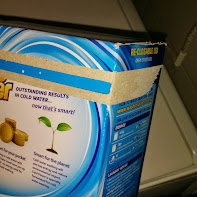
Pull-apart packaging. Cereal bags, coffee packs, band-aid envelopes - a world of ease and pleasure in opening things that used to be a complete pain to open. And milk cartons actually open the way they're supposed to now. Remember having to take a knife to them half the time in ye olden days?
Of course, there are other packaging types that are still in their "to be improved" stages
 |
| Every goddamned time |
 |
| Aaargh |
But back to the good stuff:
Hair detangling spray and equipment. These sprays (any brand) are amazing, and these brushes are MAGIC.

The multi-coloured pencil. What a marvel! Checkered paint can only be around the corner!
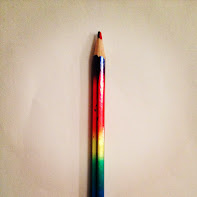
The fuel cap tether, attaching the petrol cap to the car these days. Such a little thing. Such genius.

Travel packs of wipes. Because little kids are sticky all the time, and carrying around a damp flannel in a plastic bag was not as handy.
This drain on the edges of swimming pools, that lets pools be filled to the very top. I'm pretty sure that this is recent. I remember a time when pools filled level with the ground was the stuff of top-level decadent fantasy. Now it's every pool everywhere, and it's so good.

And: mini-dodgems just for kids

What did I miss?
What innovations have improved your daily life?
Apr 21, 2014
Alternative Medicine
Last year I read the fantastic 'Trick or Treatment', by doctor and researcher Edzard Ernst and science writer Simon Singh. It is a scientific examination of alternative medicine. It does not debunk all alternative medicine - indeed some are shown to be (moderately) effective. Rather it is an examination of alternative therapies with evidence for and against, and some surprising results.
In recent years we have thankfully seen a resurgence in respect for science and more questioning and rejection of some of the more outlandish beliefs that have been popular for years. The social acceptance of atheism and the explosion in popular science writing online and in magazines and best-selling books have all been part of this.
But there has also been an impact the other way. The more strident the science fans and atheists become, the more many people are irked and even suspicious. Perhaps it makes more people cling to 'alternative' worldviews, seeing the scientists and writers as part of a bullying conspiracy.
I am angered by anti-vaccination groups and I struggle to empathise with and understand parents who don't vaccinate - but then I remember my own scepticism (due to lack of knowledge) when an anti-swine flu vaccine was developed so quickly, and when some batches of seasonal flu vaccine created adverse reactions in young children in 2010 (the problem was limited to a couple of bad batches and was not due to the vaccine itself, which is safe).
I thoroughly reject astrology, reiki, therapeutic touch and homeopathy, but I have been open minded (to some degree) on chiropractic, acupuncture and reflexology, as these at least seem to have some level of biological plausibility.
Of course I am sure a physiotherapist could have achieved the same result. But the chiropractor was still effective.
However, chiropractic for anything other than muscular-skeletal pain is completely implausible.
When my kids were babies in 2006 it became popular to take babies to chiropractors for 'colic'. I was appalled and amazed that anyone would take a baby to have its spine manipulated, or that any ethical practitioner would do such a thing, for a therapy that makes no sense at all.
But acupuncture for weight loss, infertility, quitting smoking or anything else makes no sense at all.
In fact, the authors of 'Trick or Treatment' show how neither therapy is that effective, despite seeming plausible. Acupuncture seems to make sense because of its seeming relation to the nervous system, and this is how I had assumed it worked. But in fact the 'meridians' used by acupuncturists bear no relation to the actual nervous system, and needles are only inserted under the skin, not in nerve points. This was a surprise to me and I was a bit sad to read all this about acupuncture. The ideas of ancient Chinese wisdom and 4000 years of history are so nice it is hard to give them up.
I have a friend who practices reiki, and without really discussing it we agree to disagree on such therapies. What I can say is my friend is a caring, empathetic and ethical person who does truly help people. She is gifted and intuitive in her reading of people and their ailments, and she never professes to be able to fix anything outside of her remit. She is also a qualified reflexologist and masseuse, and I can attest from experience she is very good at these therapies.
A couple of years ago my father found himself with severe, ongoing back pain. He already has a terminal illness and has had periods of pain, so his doctors - even his very good specialist - were somewhat dismissive. I do believe due to his age and underlying illness, his doctors did not give the same consideration to his pain that they would have given a younger, healthy patient. His pain was chronic. It altered his voice and his personality and often he could barely move.
I kept telling him he should ask for an x-ray. I thought he might have a slipped disc. He asked his doctor who said no, it was just muscular. I couldn't believe it. For the next few months every time I spoke to my dad I told him he needed an x-ray.
Who finally raised the alarm (apart from me)? An acupuncturist. She was feeling around his back and told him he had something strange sticking out of his spine, and said he needed an x-ray. He told his doctor who finally ordered an x-ray, and the problem was diagnosed: a large tumor on the spine that needed major surgery and months of physiotherapy afterward.
In this case, although acupuncture itself was no help, the acupuncturist certainly was.
In recent years we have thankfully seen a resurgence in respect for science and more questioning and rejection of some of the more outlandish beliefs that have been popular for years. The social acceptance of atheism and the explosion in popular science writing online and in magazines and best-selling books have all been part of this.
But there has also been an impact the other way. The more strident the science fans and atheists become, the more many people are irked and even suspicious. Perhaps it makes more people cling to 'alternative' worldviews, seeing the scientists and writers as part of a bullying conspiracy.
I am angered by anti-vaccination groups and I struggle to empathise with and understand parents who don't vaccinate - but then I remember my own scepticism (due to lack of knowledge) when an anti-swine flu vaccine was developed so quickly, and when some batches of seasonal flu vaccine created adverse reactions in young children in 2010 (the problem was limited to a couple of bad batches and was not due to the vaccine itself, which is safe).
I thoroughly reject astrology, reiki, therapeutic touch and homeopathy, but I have been open minded (to some degree) on chiropractic, acupuncture and reflexology, as these at least seem to have some level of biological plausibility.
Chiropractic
I saw a chiropractor fix my husband when his back went out some years ago. He woke up with his back having spasmed and 'stuck' and he was white and almost vomiting from pain. At that time I didn't realize chiropractic was alternative medicine. I thought it was a medical specialty, or an accepted therapy like physiotherapy. So I took him to a chiropractor. She showed me how he was all seized up on one side of his back, manipulated him a little, and he was fixed.Of course I am sure a physiotherapist could have achieved the same result. But the chiropractor was still effective.
However, chiropractic for anything other than muscular-skeletal pain is completely implausible.
When my kids were babies in 2006 it became popular to take babies to chiropractors for 'colic'. I was appalled and amazed that anyone would take a baby to have its spine manipulated, or that any ethical practitioner would do such a thing, for a therapy that makes no sense at all.
Homeopathy
When M had horrible reflux and screamed in pain, before the problem was diagnosed I bought a 'natural' medicine for 'colic' from a pharmacist. Only when I examined the bottle at home did I realise, amazed, that this popular medicine sold by a professional chemist was in fact a homeopathic waste of time and money. I tried it, but it did nothing, of course.Acupuncture
Acupuncture and reflexology have always made sense to me for the purposes of pain relief and nerve-related problems, because we know nerves are connected. You know that thing where you scratch your leg and feel a twinge somewhere else?But acupuncture for weight loss, infertility, quitting smoking or anything else makes no sense at all.
In fact, the authors of 'Trick or Treatment' show how neither therapy is that effective, despite seeming plausible. Acupuncture seems to make sense because of its seeming relation to the nervous system, and this is how I had assumed it worked. But in fact the 'meridians' used by acupuncturists bear no relation to the actual nervous system, and needles are only inserted under the skin, not in nerve points. This was a surprise to me and I was a bit sad to read all this about acupuncture. The ideas of ancient Chinese wisdom and 4000 years of history are so nice it is hard to give them up.
 |
Kung Fu Panda (Dreamworks)
|
Reiki
Reiki and therapeutic touch were debunked by a 12-year-old for an American school science fair project some years ago.I have a friend who practices reiki, and without really discussing it we agree to disagree on such therapies. What I can say is my friend is a caring, empathetic and ethical person who does truly help people. She is gifted and intuitive in her reading of people and their ailments, and she never professes to be able to fix anything outside of her remit. She is also a qualified reflexologist and masseuse, and I can attest from experience she is very good at these therapies.
The allure of alternative medicine = the limitations of conventional medicine
The authors of 'Trick or Treatment' paint a very good picture of the allure of alternative therapies. Conventional doctors are often busy and not always good at listening, the appointments are only 15 minutes and specialists can be brusque and have limited knowledge outside their specialties. In contrast a homeopath, naturopath or hypnotherapist will spend much more time with the patient, listen empathetically, and will prescribe a holistic treatment specifically tailored for that person. If nothing else, the placebo effect is triggered and the patient also feels well looked after.A couple of years ago my father found himself with severe, ongoing back pain. He already has a terminal illness and has had periods of pain, so his doctors - even his very good specialist - were somewhat dismissive. I do believe due to his age and underlying illness, his doctors did not give the same consideration to his pain that they would have given a younger, healthy patient. His pain was chronic. It altered his voice and his personality and often he could barely move.
I kept telling him he should ask for an x-ray. I thought he might have a slipped disc. He asked his doctor who said no, it was just muscular. I couldn't believe it. For the next few months every time I spoke to my dad I told him he needed an x-ray.
Who finally raised the alarm (apart from me)? An acupuncturist. She was feeling around his back and told him he had something strange sticking out of his spine, and said he needed an x-ray. He told his doctor who finally ordered an x-ray, and the problem was diagnosed: a large tumor on the spine that needed major surgery and months of physiotherapy afterward.
In this case, although acupuncture itself was no help, the acupuncturist certainly was.
May 23, 2013
The Charm of Coincidence
My dad just moved house and cleared out his stuff, and I was very happy to be given this relic from my childhood, now yellowed and cracked like ancient parchment. When I was a kid my dad went on business trips to America and on one of them he brought back this:

You can read the list of Lincoln-Kennedy coincidences, and an explanation of the "mystery", at Snopes.
Before the internet could debunk this with a simple search, I was utterly captivated by this list of coincidences. It seemed so strange (though even I could see some of the comparisons were a bit of a stretch). I didn't for a minute believe there was any kind of "fate" or weird time travel conspiracy linking Lincoln and Kennedy. I just thought it was one of life's weird, puzzling little mysteries.
Like most humans I'm fascinated by questions of chance, risk, cause and coincidence. We find it so hard to believe things are random, pure luck or unconnected. Most scientists believe this is an evolutionary 'side effect' of our beneficial ability to 'join the dots', connect and analyse.
Some examples of things we find hard to accept are random (or at least not determined by the things we think they are), are:
Some things truly are random coincidences, and some are not really coincidences at all, but just seem so because we assign meaning to the outcome.
As Richard Feynman apparently said at a lecture to demonstrate the fallacy of this type of automatic human thinking:
I think we can all read that and immediately think of instances where we have mistaken randomness for coincidence, or coincidence for meaning.
Here is another little snippet on coincidences, from the Seinfeld episode 'The Statue'. You may remember, Jerry hired a cleaner, Ray, who he suspected of stealing a figurine from his home, when he saw the same figurine in Ray's apartment. In this scene Elaine and Ray's girlfriend Rava are arguing about it.
Yes, there are. And they will always fascinate us.

You can read the list of Lincoln-Kennedy coincidences, and an explanation of the "mystery", at Snopes.
Before the internet could debunk this with a simple search, I was utterly captivated by this list of coincidences. It seemed so strange (though even I could see some of the comparisons were a bit of a stretch). I didn't for a minute believe there was any kind of "fate" or weird time travel conspiracy linking Lincoln and Kennedy. I just thought it was one of life's weird, puzzling little mysteries.
Like most humans I'm fascinated by questions of chance, risk, cause and coincidence. We find it so hard to believe things are random, pure luck or unconnected. Most scientists believe this is an evolutionary 'side effect' of our beneficial ability to 'join the dots', connect and analyse.
Some examples of things we find hard to accept are random (or at least not determined by the things we think they are), are:
- apparent psychic ability - telepathy, predicting the future
- the feeling of being stared at - the belief we can will someone to look at us by staring at them
- poker machine spins
- human evolution
- lotteries
- surviving a disaster
- meeting your partner
Some things truly are random coincidences, and some are not really coincidences at all, but just seem so because we assign meaning to the outcome.
As Richard Feynman apparently said at a lecture to demonstrate the fallacy of this type of automatic human thinking:
“You know, the most amazing thing happened to me tonight. I was coming here, on the way to the lecture, and I came in through the parking lot. And you won't believe what happened. I saw a car with the license plate ARW 357. Can you imagine? Of all the millions of license plates in the state, what was the chance I would see that particular one tonight? Amazing!”
I think we can all read that and immediately think of instances where we have mistaken randomness for coincidence, or coincidence for meaning.
Here is another little snippet on coincidences, from the Seinfeld episode 'The Statue'. You may remember, Jerry hired a cleaner, Ray, who he suspected of stealing a figurine from his home, when he saw the same figurine in Ray's apartment. In this scene Elaine and Ray's girlfriend Rava are arguing about it.
ELAINE: Well, I mean, he was in the apartment, and then it's gone and it's in your apartment.RAVA: Maybe you think we're in cahoots.ELAINE: No, no... but it is quite a coincidence.RAVA: Yes, that's all, a coincidence!ELAINE: A BIG coincidence.RAVA: Not a big coincidence. A coincidence!ELAINE: No, that's a big coincidence.RAVA: That's what a coincidence is! There are no small coincidences and big coincidences! There are just coincidences!
Yes, there are. And they will always fascinate us.
How about you? Succumbed to any good logical fallacies lately?
Apr 28, 2013
Science with Kids: Jelly Taste Test
Here's a fun activity that is cheap and easy to do, and the only call on your planning skills is to make the jelly ahead of time.
My kids know I love a few things that I'm often trying to foist on them: drawing, reading, walking, sky watching and science (whenever something is fun or interesting I point out how it relates to art, science or maths - in a probably vain attempt to avoid them thinking these subjects are too hard or too boring when it's time for them to choose electives in high school).
So I presented this as a fun thing and an interesting thing: "I wonder if we'll be able to tell what flavour is what? Gee, it's kind of like an Inquiry [school science] activity, huh?"
The Jelly Taste Test
Hypothesis: that we wouldn't be able to distinguish all the flavours blindfolded.
Test method: blindfolded taste test
Equipment:

Modifications:
Method:
Pretty much as you'd expect:

We first did this about 6 months ago and the kids loved it, and last week they requested it again.
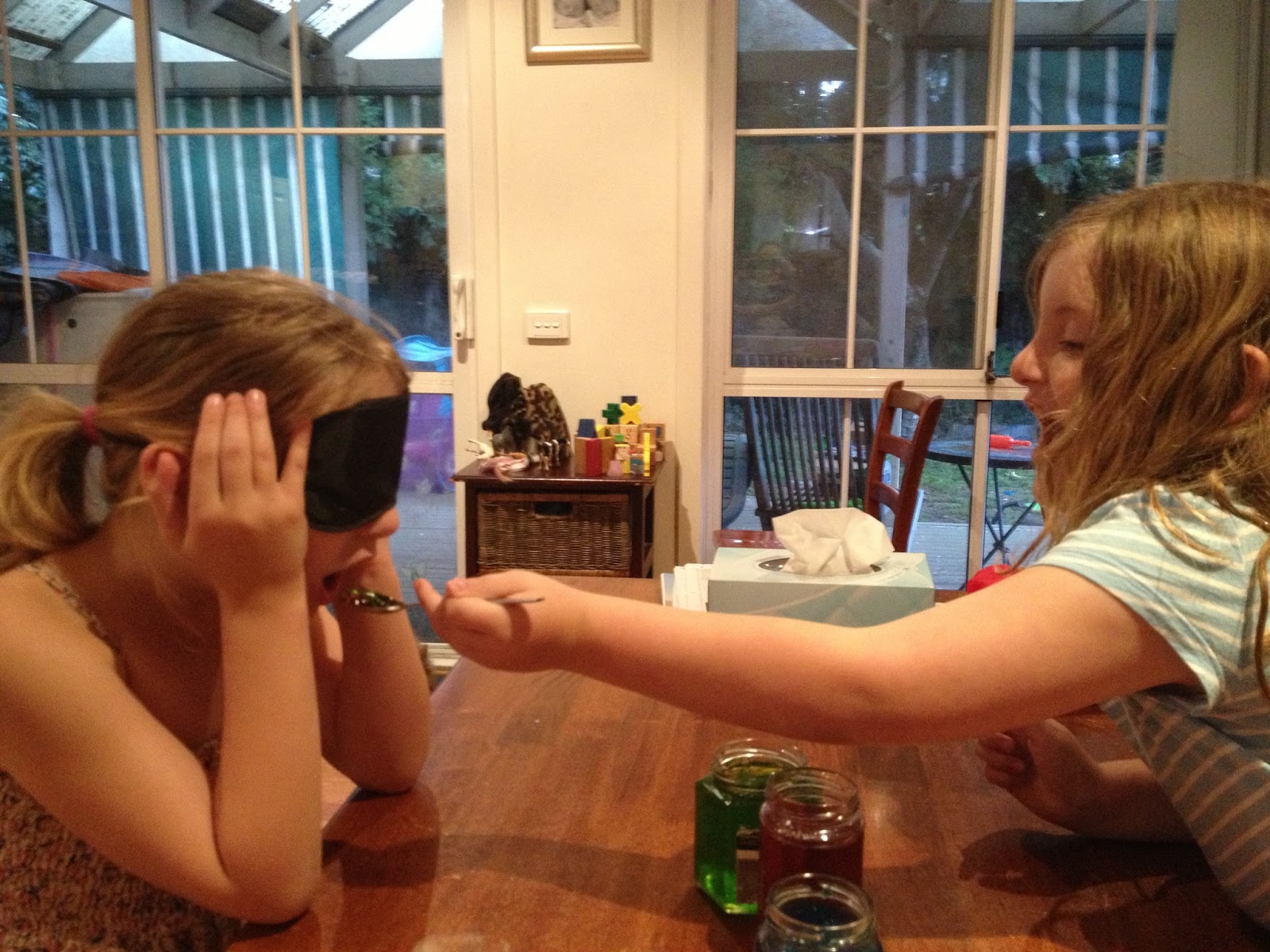
This time I let them each choose 2 flavours of jelly crystals and made up the jelly one colour at a time, pouring each one into 2 jam jars, before rinsing the mixing bowl and starting the next one.
We got through the first round pretty quickly, and found the same results we had last time: citrus flavours and lighter colours are easier to distinguish than reds and blues.


We added a second difficulty level: two colours per bite.

Then a third: three colours. This was impossible.

When we'd exhausted all taste test possibilities, we overlapped colours on the spoons and examined the new colours produced.


After that, the kids just got stuck into eating the rest of the jelly.

My kids know I love a few things that I'm often trying to foist on them: drawing, reading, walking, sky watching and science (whenever something is fun or interesting I point out how it relates to art, science or maths - in a probably vain attempt to avoid them thinking these subjects are too hard or too boring when it's time for them to choose electives in high school).
So I presented this as a fun thing and an interesting thing: "I wonder if we'll be able to tell what flavour is what? Gee, it's kind of like an Inquiry [school science] activity, huh?"
The Jelly Taste Test
Hypothesis: that we wouldn't be able to distinguish all the flavours blindfolded.
Test method: blindfolded taste test
Equipment:
- children
- jelly made up in various flavours, in separate containers
- blindfold
- spoon(s)

Modifications:
- I chose 4 flavours that were very different to each other, to make some of the guessing easy. But you could devilishly try blueberry and bubblegum (blue and blue), or raspberry, strawberry and port wine (red, red, red), or lemon and pineapple (yellow and yellow).
Beware of:
- attempts to peek, grumpiness at failing to guess correctly
Method:
Pretty much as you'd expect:

We first did this about 6 months ago and the kids loved it, and last week they requested it again.
This time I let them each choose 2 flavours of jelly crystals and made up the jelly one colour at a time, pouring each one into 2 jam jars, before rinsing the mixing bowl and starting the next one.
We got through the first round pretty quickly, and found the same results we had last time: citrus flavours and lighter colours are easier to distinguish than reds and blues.


We added a second difficulty level: two colours per bite.

Then a third: three colours. This was impossible.

When we'd exhausted all taste test possibilities, we overlapped colours on the spoons and examined the new colours produced.

Jelly is so pretty!


After that, the kids just got stuck into eating the rest of the jelly.

Yeah science!!
Apr 11, 2013
If Your Kid Gobbles the Marshmallow, Take Heart
If you have ever watched a video of kids being given the marshmallow test and had the feeling your kid would not pass, you're not alone. I have too.
The marshmallow test was devised in the 1960's and is one of the most well-known experiments in psychology. A child is offered the choice between one marshmallow now, or two if they wait. The researcher explains the test, places one marshmallow in front of the child, and leaves the room for 15 minutes. Children will either succumb to the "now" and eat the marshmallow, or will wait (most with much difficulty, providing extra amusement for viewers of the experiment on YouTube videos). Those who wait are rewarded with two marshmallows when the researcher returns.
This test has been thought to hold ramifications for life success. Successive studies and theories have posited a biological basis for delayed gratification, with correlation between how well children delay gratification and how well they do in life; longitudinal studies showed the children who waited for the two marshmallows had less obesity, higher academic performance, better relationships and more successful careers.
Cue uncomfortable feelings of parents like me watching these tests and just KNOWING their kid would fail.
Thankfully for us and our kids, more recent studies have put a different spin on this test.
A study last year concluded that kids who have experienced upheaval or unpredictability in their lives tended to eat the first marshmallow, and that this was for them the most rational choice - nothing to do with will power.
A study published last month has concluded that most examples of the marshmallow test were flawed, because the children did not truly understand how long it would be until the researcher returned. Therefore, with the timing of the two-marshmallow payoff uncertain, it made rational sense to eat the marshmallow available now.
And we all know how terrible children are at estimating time. Whether a child is told "15 minutes" or "in a little while" little kids have no idea how long that is going to be.
I'm pretty sure some kids are born with better self-control than others. Some probably also like marshmallows more than others. Some have more of a desire to please. And some get hungrier faster.
I guess the real take-away here is not to worry too much about these psychological tests. They are fascinating and can tell us something, but they don't tell us everything.
Here is a clip of kids doing the marshmallow test.
And be warned: it is not very scientific to do this test on your own kids!
The marshmallow test was devised in the 1960's and is one of the most well-known experiments in psychology. A child is offered the choice between one marshmallow now, or two if they wait. The researcher explains the test, places one marshmallow in front of the child, and leaves the room for 15 minutes. Children will either succumb to the "now" and eat the marshmallow, or will wait (most with much difficulty, providing extra amusement for viewers of the experiment on YouTube videos). Those who wait are rewarded with two marshmallows when the researcher returns.
This test has been thought to hold ramifications for life success. Successive studies and theories have posited a biological basis for delayed gratification, with correlation between how well children delay gratification and how well they do in life; longitudinal studies showed the children who waited for the two marshmallows had less obesity, higher academic performance, better relationships and more successful careers.
Cue uncomfortable feelings of parents like me watching these tests and just KNOWING their kid would fail.
Thankfully for us and our kids, more recent studies have put a different spin on this test.
A study last year concluded that kids who have experienced upheaval or unpredictability in their lives tended to eat the first marshmallow, and that this was for them the most rational choice - nothing to do with will power.
A study published last month has concluded that most examples of the marshmallow test were flawed, because the children did not truly understand how long it would be until the researcher returned. Therefore, with the timing of the two-marshmallow payoff uncertain, it made rational sense to eat the marshmallow available now.
And we all know how terrible children are at estimating time. Whether a child is told "15 minutes" or "in a little while" little kids have no idea how long that is going to be.
I'm pretty sure some kids are born with better self-control than others. Some probably also like marshmallows more than others. Some have more of a desire to please. And some get hungrier faster.
I guess the real take-away here is not to worry too much about these psychological tests. They are fascinating and can tell us something, but they don't tell us everything.
Here is a clip of kids doing the marshmallow test.
And be warned: it is not very scientific to do this test on your own kids!
Feb 22, 2013
Science and Religion
Science and religion. 'And' - not 'versus'. No need.
As Julian Burnside tweeted this week:
I am an atheist, and I LOVE science. But I am not anti-religion. Religion is part of who we are as humans, and it serves multiple purposes. Religious people are probably on the whole happier, and more comforted. And we all, somewhere, retain a little bit of religious sentiment, hope or belief, even if we consciously reject it.
My kids were baptized Greek Orthodox, but we don't go to church. They opt in to religious instruction in school, though I would prefer it were not offered. I don't send them to learn ethics or how to be a good person, because you don't need religion for that. I send them because it's a huge part of human culture and society, and because religion gave me some comfort as a child. (Actually I took A out last year, because she hated it. M loves it. A wants to try again this year because her friends go, so we'll see how it goes. I've made it clear she doesn't have to go).
I answer my kids' questions about God and religion honestly (more honestly than I answer their questions about Santa).
Last week my kids learned the truth about the tooth fairy. This year I expect they'll figure out the truth about the Easter Bunny and Santa. But the truth about God and religion is not an easy one and one they will decide for themselves along the way.
Like the books on this trestle table, why can't we all just get along?

As Julian Burnside tweeted this week:
#qanda Science and Religion shine their light in utterly different places
— julianburnside (@JulianBurnside) February 18, 2013
I am an atheist, and I LOVE science. But I am not anti-religion. Religion is part of who we are as humans, and it serves multiple purposes. Religious people are probably on the whole happier, and more comforted. And we all, somewhere, retain a little bit of religious sentiment, hope or belief, even if we consciously reject it.
My kids were baptized Greek Orthodox, but we don't go to church. They opt in to religious instruction in school, though I would prefer it were not offered. I don't send them to learn ethics or how to be a good person, because you don't need religion for that. I send them because it's a huge part of human culture and society, and because religion gave me some comfort as a child. (Actually I took A out last year, because she hated it. M loves it. A wants to try again this year because her friends go, so we'll see how it goes. I've made it clear she doesn't have to go).
I answer my kids' questions about God and religion honestly (more honestly than I answer their questions about Santa).
Last week my kids learned the truth about the tooth fairy. This year I expect they'll figure out the truth about the Easter Bunny and Santa. But the truth about God and religion is not an easy one and one they will decide for themselves along the way.
Like the books on this trestle table, why can't we all just get along?

Nov 11, 2012
Sugar and Spice and Puppy Dog Tails
"Sugar and spice and everything nice,
That's what little girls are made of.
Snips of snails and puppy dog tails,
That's what little boys are made of."
 |
| 'Child in Nature' by chrisroll via FreeDigitalImages.net |
Take a look at the following statements. Which ones are true, which are a myth, and which are sometimes true, or partly true?
"Girls - there's always drama. There's always someone in tears, or they're all hugging. Thank goodness, boys are not like that!"
"Boys are straightforward. If they're mad at each other they'll have it out and move on.
There's no bitchiness or backstabbing."
"Boys like rough and tumble games."
"Boys are so full of energy; they just can't sit still!"
"Boys are pretty simple really. Very straightforward, what you see is what you get."
"Men/boys are visual creatures."
"Men/boys are not good at expressing their feelings."
While there is truth to some of these, and I do agree there are differences between boys and girls, I think we do our boys (and girls) a huge disservice by perpetuating the "boys are simple and straightforward" myth.
Mars Vs Venus has been discredited.
To suggest that boys are somehow wired less psychologically complex than girls is not only insulting, it is ridiculous. It makes no sense biologically or psychologically, or even logically.
I've known some sensitive "still waters" little boys, and some energetic rough and tumble girls, and I find all humans equally complex, no matter how simple their views or approach to life.
Gendered cordial by Cottees - via @Pink_Soprano on Twitter:

What bugs you about pop psychology?
Sep 12, 2012
Barbie Science
One of my favourite science bloggers on Twitter, Christie Wilcox ("NerdyChristie"), retweeted a story from Scientific American last night which had been picked up by biologist Miriam Goldstein.
(As you can see, attributing stories found via Twitter can get quite complex)
The Trouble With Barbie Science
Recruiting women into the sciences with girly images can backfire
READ this if you have girls, or are a girl, and RELATE.
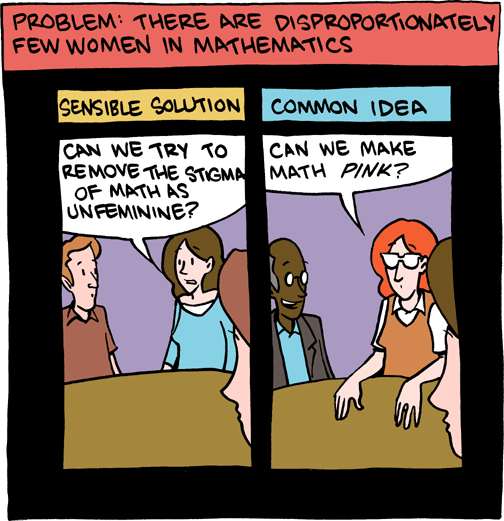
With all the best intentions in the world, there are attempts being made to attract girls to "STEM" (science, technology, engineering and maths) using "girly" aesthetics. The intention is not evil but to get girls away from thinking "that's boring" or "that's a boy thing".
Any parent (that's all of us, right?) who has sighed in frustration at the "pinkification" of everything for girls, will probably be gritting their teeth a little by now.
On Twitter, Miriam Goldstein compared the pinkification of science to [unintentionally] saying to girls: "See girls? It's OK to be smart as long as you conform to the feminine ideal!"
But not only is the message going out unintentionally problematic - it appears not to work.
Two scientists ran a study gauging the impact on girls' interest in STEM after viewing different types of female role model: "girly" STEM women, non-"girly" STEM women, "girly" other women and non-"girly" other women.
The scientists' conclusion was that the "Barbie Scientist" role models were too daunting - being super-smart and successful PLUS girly and sexy is just too damn high a bar to reach. Girls see this and doubt they can do it, so they abandon any interest.
I absolutely agree with this interpretation. I have never articulated it like that, but have had the same heart-sinking feeling myself on occasion and hesitate to present some of these types of images to my girls for the same reason. It's the same reason I feel conflicted over Barbies with cool careers.
Between the ages of 5 and 35, girls are swimming in pressure to be hot. Not just pretty - but glamorous and sexy and confident and flirty, as well as organised, healthy and cool. Once upon a time, applying oneself to "neutral" or "tomboy" pursuits was a way to get a pass on some of this pressure. No longer.
So... You mean I STILL have to be sexy even if I'm successful and super-smart? Do I NEVER get a break from this stuff?
Poor girls!
The only good thing? I sense we're at a tipping point on the pinkification thing. Change, at last, is a-coming.
(As you can see, attributing stories found via Twitter can get quite complex)
The Trouble With Barbie Science
Recruiting women into the sciences with girly images can backfire
READ this if you have girls, or are a girl, and RELATE.
With all the best intentions in the world, there are attempts being made to attract girls to "STEM" (science, technology, engineering and maths) using "girly" aesthetics. The intention is not evil but to get girls away from thinking "that's boring" or "that's a boy thing".
Any parent (that's all of us, right?) who has sighed in frustration at the "pinkification" of everything for girls, will probably be gritting their teeth a little by now.
On Twitter, Miriam Goldstein compared the pinkification of science to [unintentionally] saying to girls: "See girls? It's OK to be smart as long as you conform to the feminine ideal!"
But not only is the message going out unintentionally problematic - it appears not to work.
Two scientists ran a study gauging the impact on girls' interest in STEM after viewing different types of female role model: "girly" STEM women, non-"girly" STEM women, "girly" other women and non-"girly" other women.
You may or may not be surprised to hear the outcome of the experiment. Girls became LEAST interested in STEM after seeing the "girly" STEM models.
The scientists' conclusion was that the "Barbie Scientist" role models were too daunting - being super-smart and successful PLUS girly and sexy is just too damn high a bar to reach. Girls see this and doubt they can do it, so they abandon any interest.
I absolutely agree with this interpretation. I have never articulated it like that, but have had the same heart-sinking feeling myself on occasion and hesitate to present some of these types of images to my girls for the same reason. It's the same reason I feel conflicted over Barbies with cool careers.
Between the ages of 5 and 35, girls are swimming in pressure to be hot. Not just pretty - but glamorous and sexy and confident and flirty, as well as organised, healthy and cool. Once upon a time, applying oneself to "neutral" or "tomboy" pursuits was a way to get a pass on some of this pressure. No longer.
So... You mean I STILL have to be sexy even if I'm successful and super-smart? Do I NEVER get a break from this stuff?
Poor girls!
The only good thing? I sense we're at a tipping point on the pinkification thing. Change, at last, is a-coming.
 |
| Cartoon by Zack Weiner at SMBC Comics (embedding allowed) |
Sep 6, 2012
An Unscientific Study: Does Wild Wind Affect Kids' Behaviour?
Yesterday here in Melbourne town we had some very wild windy weather. Winds up to 140km/hr hit much of the state causing havoc.
In my house some havoc reigned as well, albeit not as serious as those houses which suffered damage- not to make light of that by any means. The kids were unsettled all day, and a little freaked out at night-time when the winds picked up and we put the dog outside. M was frightened poor Harry would "get blown away", and while I assured her that could never happen, it did give me pause for our fluffy little guy for a moment.
(He was fine, if a little alarmed).
Today I noticed this post from No Excuses! which grabbed my attention thusly:
"When ever there is gale forced winds, children (and animals too) tend to play up big time. They are rowdy, psycho, loud, full of energy and just constantly on the go (more so than normal). To sum it up in one word they are WILD."
This reminded me that my cousin - who has had kids a bit longer than me and is a wise and practical mum - has always said the same thing, that kids turn rowdy in windy weather. And that, subsequent to her pointing it out, I had noticed the same thing myself. At least I think I have.
Intrigued, I hit Google with "kids behaviour and windy weather" and found quite a bit:
So what to think, what to think? Is this a real thing? Or is it a myth, as most serious studies infer is the belief that the full moon influences behavior? (I know many, many people swear it does, but I admit I am not a believer on this one).
Does it sit in myth-busted but much contested territory like the idea that sugar causes kids to be hyperactive?
I am conflicted on some of these beliefs. On the one hand as a respecter of science, I'm not keen to argue with empirical evidence, and you have to listen when multiple studies show no valid causation link. On the other hand, it irks me when the real-world, long-term and consistent experience of mothers and teachers is dismissed out of hand because someone can't replicate it in a lab. That, I believe, happens a little too often.
Well first, let me look to my own behaviour. There's wind and there's wind. Cold, blustery, rainy windy weather is not my thing, and it does not affect me, other than make me cold and annoyed. But I love hot dry windy days (though I know they're a fire hazard), and I do perk up and feel outdoorsy and energetic in them. As a teenager I remember my sister comparing me to our red setter on a windy day - which was flattering, as you can imagine. But I'll admit the comparison was fair.
So I relate to the Best Answer poster in Yahoo Answers and also to the poster on the ABC Science thread who wrote "I'm like a pixie on speed on a windy day".
What about my kids? Well, yesterday on our gusty Melbourne day my kids were a handful, but can I blame the wild windy weather?
A lot had gone on in our house of late. In the last 3 months, the kids have been on an overseas odyssey, I've broken my arm, our work and school routines have changed, and the kids have experienced some of the usual but upsetting schoolyard dramas that inhabit the world of girls.
This past week I had an operation to pin my arm and then was sick. Yesterday was my first day back working (from home thankfully), and it coincided with the Victorian teachers' strike which meant the kids were home too. My mother was on hand to manage the kids so I could work, but it was a strange day. The kids were unsettled and were not used to having me up and about. I had just resurfaced from a weird lost week that began with an operation and two days of drugged-out (blissful) recovery, followed by 3 days of illness, which took me out of our family's action for 6 strange, bedridden days. The upheaval to our family life had left all of us tired and unsettled.
So... we are a long way from a controlled experiment into the weather's impact on kids' behaviour at my place. But I'm not ruling it out.

 |
| Photo of St Kilda beach, not near my house, and not taken yesterday. Similar weather though. |
In my house some havoc reigned as well, albeit not as serious as those houses which suffered damage- not to make light of that by any means. The kids were unsettled all day, and a little freaked out at night-time when the winds picked up and we put the dog outside. M was frightened poor Harry would "get blown away", and while I assured her that could never happen, it did give me pause for our fluffy little guy for a moment.
 |
| Harry attends to the call of the mild |
(He was fine, if a little alarmed).
Today I noticed this post from No Excuses! which grabbed my attention thusly:
"When ever there is gale forced winds, children (and animals too) tend to play up big time. They are rowdy, psycho, loud, full of energy and just constantly on the go (more so than normal). To sum it up in one word they are WILD."
This reminded me that my cousin - who has had kids a bit longer than me and is a wise and practical mum - has always said the same thing, that kids turn rowdy in windy weather. And that, subsequent to her pointing it out, I had noticed the same thing myself. At least I think I have.
Intrigued, I hit Google with "kids behaviour and windy weather" and found quite a bit:
- From the UK Daily Mail, an article from April 2011, "Strike-hit school Governor blames pupil anarchy ... on wind and rain"
- From a Montessori pre-school in Maine, USA, a blog post from October 2011, "Windy Days at School" - which includes this lovely line: "After 5 years of observing children’s behavior I can accurately report windy days= silly days, even in a Montessori classroom"
- a post on the blog of the author of What to Expect When You're Expecting, from August 2011, "Child Behaviour Problems: Rain, Rain Go Away". This post refers to "hot, dry and windy" weather and to a book which posits that "wind can make people psychologically unsettled because it changes the ion content of the air which in turn can effect blood pressure, allergies and a whole host of physical systems "
- Discussion forums on ABC Online, where one person posits that wind represents "tactile, auditory and visual stimulation" and many report the same impact on horses galloping in paddocks on windy days
- Discussion forum on Yahoo Answers, where the best answer referred to ions and chemicals impacting behaviour, and also (I like this a lot): "it is possible that truly windy days bring forth excitement from the child- i am a young adult and the strong winds excite me still as it is unusual and partially scary watching trees bend in odd ways. it may simply be a release of adrenalin"
- Discussion forums on parenting blogs such as Essential Baby
- Personal blog posts by parents, such as this one
So what to think, what to think? Is this a real thing? Or is it a myth, as most serious studies infer is the belief that the full moon influences behavior? (I know many, many people swear it does, but I admit I am not a believer on this one).
Does it sit in myth-busted but much contested territory like the idea that sugar causes kids to be hyperactive?
I am conflicted on some of these beliefs. On the one hand as a respecter of science, I'm not keen to argue with empirical evidence, and you have to listen when multiple studies show no valid causation link. On the other hand, it irks me when the real-world, long-term and consistent experience of mothers and teachers is dismissed out of hand because someone can't replicate it in a lab. That, I believe, happens a little too often.
Does the weather (especially wind) influence behaviour?
 |
| Thank you, Microsoft clipart. Not a red setter but close enough. |
So I relate to the Best Answer poster in Yahoo Answers and also to the poster on the ABC Science thread who wrote "I'm like a pixie on speed on a windy day".
What about my kids? Well, yesterday on our gusty Melbourne day my kids were a handful, but can I blame the wild windy weather?
A lot had gone on in our house of late. In the last 3 months, the kids have been on an overseas odyssey, I've broken my arm, our work and school routines have changed, and the kids have experienced some of the usual but upsetting schoolyard dramas that inhabit the world of girls.
This past week I had an operation to pin my arm and then was sick. Yesterday was my first day back working (from home thankfully), and it coincided with the Victorian teachers' strike which meant the kids were home too. My mother was on hand to manage the kids so I could work, but it was a strange day. The kids were unsettled and were not used to having me up and about. I had just resurfaced from a weird lost week that began with an operation and two days of drugged-out (blissful) recovery, followed by 3 days of illness, which took me out of our family's action for 6 strange, bedridden days. The upheaval to our family life had left all of us tired and unsettled.
So... we are a long way from a controlled experiment into the weather's impact on kids' behaviour at my place. But I'm not ruling it out.

What about you? Does the wind affect you or your kids? Tell me a story!
Jul 22, 2011
Science I Like - 1: Drink When You're Thirsty
About time I lived up to my blog description and put some "science" up.
There are so many excellent science blogs out there, written by like, actual scientists, that I hesitate to post comments on much of it. But stuff in the lifestyle section - that I can handle!
So... water. How much do you need to drink?
Answer, as of this week: as much or as little as you want!
Don't you love it when a new study frees you from sticking to some kind of health rule? I sure do. Last week news was made when the British Medical Journal published an article by Scottish GP Dr Margaret McCartney arguing that the common advice to drink 6-8 glasses of water a day was "nonsense". (A good, stern, Scottish-type word, that).
You can read about this, and the "backlash", here. (The comments on this news article are also good reading, as a summary of the varying beliefs held by most of us on this topic).
Now I LOVE water, and I am a big water drinker. Water has always been my preferred drop and I drink it throughout the day. When I was a kid I dreamed of being able to buy water in shops - really! In Australia in the 70's it was all milkshakes and Coke once you left your front door.
But I don't like blanket prescriptions. As in "8 glasses of water a day". At its height, this belief got ridiculous, with some people recommending up to 4 litres of water a day. Granted, these were not necessarily doctors and scientists, but the general advice for a long time has basically been to drink MUCH more water than you think you want.
Another gem I am waiting to be debunked: "Thirst often masquerades as hunger". I was open minded on this and I have tried to believe it when I am hungry. But seriously, I don't think so.
What about this guy - is he actually hungry?
So what about you?
What everyday health - or other - "facts" have you been happy to see debunked?
There are so many excellent science blogs out there, written by like, actual scientists, that I hesitate to post comments on much of it. But stuff in the lifestyle section - that I can handle!
So... water. How much do you need to drink?
Answer, as of this week: as much or as little as you want!
 |
| Photo by polandeze via Flickr Creative Commons |
Don't you love it when a new study frees you from sticking to some kind of health rule? I sure do. Last week news was made when the British Medical Journal published an article by Scottish GP Dr Margaret McCartney arguing that the common advice to drink 6-8 glasses of water a day was "nonsense". (A good, stern, Scottish-type word, that).
You can read about this, and the "backlash", here. (The comments on this news article are also good reading, as a summary of the varying beliefs held by most of us on this topic).
Now I LOVE water, and I am a big water drinker. Water has always been my preferred drop and I drink it throughout the day. When I was a kid I dreamed of being able to buy water in shops - really! In Australia in the 70's it was all milkshakes and Coke once you left your front door.
But I don't like blanket prescriptions. As in "8 glasses of water a day". At its height, this belief got ridiculous, with some people recommending up to 4 litres of water a day. Granted, these were not necessarily doctors and scientists, but the general advice for a long time has basically been to drink MUCH more water than you think you want.
Another gem I am waiting to be debunked: "Thirst often masquerades as hunger". I was open minded on this and I have tried to believe it when I am hungry. But seriously, I don't think so.
What about this guy - is he actually hungry?
 |
| Photo by Ajagendorf25 via Flickr Creative Commons |
So what about you?
What everyday health - or other - "facts" have you been happy to see debunked?
Mar 28, 2011
Wait one hour after eating
...and while on the subject of myths, does anyone (presumably my age - Gen X - and older) remember this one?
"You can't go swimming for an hour after eating."
Mar 27, 2011
Limitless… are the things I don’t know about memory
If you want to see a fun, sexy movie see Limitless. I loved it. Because damn, that Bradley Cooper can wear a suit. But also, because the story is built around an interesting idea.
The premise is the enduring (and false) belief that “we only use 20% of our brains” (I have always heard 10% - maybe we’re getting smarter), and what if you could “access all of it”? And what if a pill could do that?
The premise is the enduring (and false) belief that “we only use 20% of our brains” (I have always heard 10% - maybe we’re getting smarter), and what if you could “access all of it”? And what if a pill could do that?
Mar 19, 2011
Divine Retribution? End of Days? Or a very unlucky streak? Disaster Days
What with natural disasters, climate change, the end of carbon, terrorism, wars, the global financial crisis, and the frightening rise of violence and viciousness in our cities, at some point we all wonder, What’s going on?
Feb 25, 2011
Copernicus for Five Year Olds
Don't you love it when you have a really good conversation with your kids about Life, The Universe and Everything?
My kids are five and are only three weeks in school, but they seem suddenly to have streaked ahead of where they were a month ago.
My kids are five and are only three weeks in school, but they seem suddenly to have streaked ahead of where they were a month ago.
Dec 13, 2010
Interesting Dangerous Idea
More on a topic I love, correlation vs causation.
Michael Agger from Slate Magazine has been soliciting ideas for how to use data from online sources such as social networking sites, for making improvements in our lives.
One of the suggestions was The Correlations Project, which proposes:
"I want to see a website that lets me keep track of something simple for a set period of time, and then compares it to a database to search for correlations. For example, over the course of a week or month or year, or even on an ongoing basis, it could ask, "What did you have for breakfast today?" or "What color shirt did you wear today?" or "How many calls did you get on your cell phone today?" Maybe a daily e-mail would remind you to log in with the answers. Then it would compare the answers to other things that are already tracked such as the stock market, phases of the moon, sports scores, etc., and spit out some correlations. It could tell you "On 93% of the days on which you ate eggs for breakfast, the stock market went up." Or, "When the moon is waxing, you are 88% more likely to wear a green shirt than when it is waning." Or, "On days when you get more than 7 phone calls, the Yankees win their games."
Agger explains: "The point of the correlations project, according to the submitter "IronicSans," is to demonstrate the axiom that correlation does not imply causation." He points out the ubiquitousness of coincidences and our tendancy to see links and cause where none exist, and he quotes the case of Paul the Octopus as one example.
A really interesting idea. I have a feeling though that the correlations brought up would become the point in themselves, the site would become a mecca for people believing in its power and accuracy, and in the end it would achieve the complete opposite of what it set out to do!
Michael Agger from Slate Magazine has been soliciting ideas for how to use data from online sources such as social networking sites, for making improvements in our lives.
One of the suggestions was The Correlations Project, which proposes:
"I want to see a website that lets me keep track of something simple for a set period of time, and then compares it to a database to search for correlations. For example, over the course of a week or month or year, or even on an ongoing basis, it could ask, "What did you have for breakfast today?" or "What color shirt did you wear today?" or "How many calls did you get on your cell phone today?" Maybe a daily e-mail would remind you to log in with the answers. Then it would compare the answers to other things that are already tracked such as the stock market, phases of the moon, sports scores, etc., and spit out some correlations. It could tell you "On 93% of the days on which you ate eggs for breakfast, the stock market went up." Or, "When the moon is waxing, you are 88% more likely to wear a green shirt than when it is waning." Or, "On days when you get more than 7 phone calls, the Yankees win their games."
Agger explains: "The point of the correlations project, according to the submitter "IronicSans," is to demonstrate the axiom that correlation does not imply causation." He points out the ubiquitousness of coincidences and our tendancy to see links and cause where none exist, and he quotes the case of Paul the Octopus as one example.
A really interesting idea. I have a feeling though that the correlations brought up would become the point in themselves, the site would become a mecca for people believing in its power and accuracy, and in the end it would achieve the complete opposite of what it set out to do!
Nov 17, 2010
Parenting as Addiction
Okay, so this is a blog quoting a blog quoting another blog, but I don't want to make it look like I found this item all by myself. This is a new post at Freakonomics that I like.
It's a theory that says parents continue procreating even though parenting is hard/miserable/stressful/etc, because they are addicted to the rush they get when their children do something lovely.
I love the economists.
I read stuff like this and my reactions are: recognition, partial agreement, amusement, and exasperation (bloody economists! Have to boil everything down to incentives!).
But it is a funny and clever take on parenthood from a behavioural economics-style perspective.
(Though the original article they quote is by a journalist, not an economist, and is a wonderful read)
I think it's partially true but I do think that the "addiction" to the joyful moments is actually a side-issue, tangentially related to why we "continue to procreate". Isn't the real reason just that it is such a strong biological imperative? This is enough of a reason because it is the basis of all life. All life wants to exist and then pass itself on, that's pretty much what life boils down to in its essentials. No one has to explain or defend procreating, to my mind, when it's such a basic, compelling biological urge - we often feel we more or less have no say in it.
[Which is not to say everyone has to do it, or life is nothing without it. Not at all. I don't think anyone needs to explain or defend either state - having children or not having them - both are completely natural states].
The "addiction" factor probably kicked in somewhere along the way as an adaptation that helped the process, but I don't think it is the reason.
It probably is the reason we don't always give into despair and depression at the daily grind, because we do remind ourselves about these "rewards" to balance the hard bits.
But anyway have a read, because it's good. Here's a sampler:
“The unexpected, kind, and loving things that children do produce chemical surges in their parents’ brains like the rush of the pipe or the needle. Like addicts, parents will sacrifice anything for the glimpses of heaven that their offspring periodically provide.”
- Shankar Vedantam at Slate, quoted at freakonomics
I like the "periodically" !
It's a theory that says parents continue procreating even though parenting is hard/miserable/stressful/etc, because they are addicted to the rush they get when their children do something lovely.
I love the economists.
I read stuff like this and my reactions are: recognition, partial agreement, amusement, and exasperation (bloody economists! Have to boil everything down to incentives!).
But it is a funny and clever take on parenthood from a behavioural economics-style perspective.
(Though the original article they quote is by a journalist, not an economist, and is a wonderful read)
I think it's partially true but I do think that the "addiction" to the joyful moments is actually a side-issue, tangentially related to why we "continue to procreate". Isn't the real reason just that it is such a strong biological imperative? This is enough of a reason because it is the basis of all life. All life wants to exist and then pass itself on, that's pretty much what life boils down to in its essentials. No one has to explain or defend procreating, to my mind, when it's such a basic, compelling biological urge - we often feel we more or less have no say in it.
[Which is not to say everyone has to do it, or life is nothing without it. Not at all. I don't think anyone needs to explain or defend either state - having children or not having them - both are completely natural states].
The "addiction" factor probably kicked in somewhere along the way as an adaptation that helped the process, but I don't think it is the reason.
It probably is the reason we don't always give into despair and depression at the daily grind, because we do remind ourselves about these "rewards" to balance the hard bits.
But anyway have a read, because it's good. Here's a sampler:
“The unexpected, kind, and loving things that children do produce chemical surges in their parents’ brains like the rush of the pipe or the needle. Like addicts, parents will sacrifice anything for the glimpses of heaven that their offspring periodically provide.”
- Shankar Vedantam at Slate, quoted at freakonomics
I like the "periodically" !
Nov 16, 2010
The Feeling of Being Stared At
When I started this blog I was intending to spend more time "researching" (i.e., web-surfing) varied questions and phenomena in the worlds of science, economics and psychology. Then I quickly found that (a) I have no time, and (b) there are thousands of people out there doing this already. Also (c) my knowlege in these areas is even more limited than I thought, and I have a fear of posting about something that it turns out I have completely misunderstood or missed reams of research which has resolved any questions I thought were still outstanding. It's a long time since I was in the halls of academia...
Case in point:
One of the things that has intrigued me for years is that thing where you "feel" someone watching you, look up and see someone staring at you, or vice versa.
My mother alerted me to this when I was a kid; she told me that when she was a teenager hanging out with her friends if one of them liked a boy they had a trick where they would stare at the back of his head and he would turn around.
This has interested me for years, because it sort of makes sense (evolutionary advantage, awareness of predators etc) and most people have experienced it, but there also seems no physical explanation for it. It's not like you can be picking up subliminal cues* of any kind, unless you are facing a mirror.
Another interesting point is that it only seems to "work" when people are not distracted on things that require a lot of concentration - no matter how much you stare at someone arguing on a telephone or watching the last stretch of a horse race, you will not "make" them turn around.
I had not come across any articles or books on this or even any mention of it in studies in other things, and I wasn't sure how to search to find if any research had been done.
Obviously I hadn't thought to Google "the feeling of being stared at".
Because it turns out there has been lots of research on this (see here and here) and while "the jury is out" to some degree, the non-fringe consensus is that this "phenomenon" has been debunked.
I came across the fact of this research while reading a fantastic book, The Invisible Gorilla (Christopher Chabris and Daniel Simons, Harper Collins 2010). In the chapter "Get Smart Quick!" they assert that this belief, held by 65% of people, has been "thoroughly debunked" with research going back to 1898. Who knew?!
I'm a bit torn here. Logically speaking I do love a debunking - if it's done well and out of good scientific intentions and not gleeful vindictiveness.
And it's always embarassing to be caught out believing something weird for which there is a simple and natural explanation. (The Invisible Gorilla puts belief in this phenomenon in the same chapter as beliefs about brain training, the Mozart effect and the belief that we only use 10% of our brains. Not great finding yourself in that company).
On the other hand... like a lot of people, I feel like I have tried this and found it to work.
I know it's easy to believe something using selective memory especially when the belief is a seductive one (handy skill, to know when being watched). But still it's hard to resist the feeling that this is a real thing.
Clearly I need to re-experiment with my new perspective and keep a faithful tally of the times people don't turn around, or all the times I look up and don't lock eyes with someone staring at my head.
I shall repair to the lab and report back in due course...
Interesting footnote -
*Just today I came across some research in a related topic, which DOES have a logical, "subliminal cues" explanation: "gaze-following".
There is an interesting post about this on the ScienceBlogs site, about Gaze-Following in Red Footed Tortoises
Case in point:
One of the things that has intrigued me for years is that thing where you "feel" someone watching you, look up and see someone staring at you, or vice versa.
 |
| Image: Graur Codrin, freedigitalphotos.net |
My mother alerted me to this when I was a kid; she told me that when she was a teenager hanging out with her friends if one of them liked a boy they had a trick where they would stare at the back of his head and he would turn around.
This has interested me for years, because it sort of makes sense (evolutionary advantage, awareness of predators etc) and most people have experienced it, but there also seems no physical explanation for it. It's not like you can be picking up subliminal cues* of any kind, unless you are facing a mirror.
Another interesting point is that it only seems to "work" when people are not distracted on things that require a lot of concentration - no matter how much you stare at someone arguing on a telephone or watching the last stretch of a horse race, you will not "make" them turn around.
I had not come across any articles or books on this or even any mention of it in studies in other things, and I wasn't sure how to search to find if any research had been done.
Obviously I hadn't thought to Google "the feeling of being stared at".
Because it turns out there has been lots of research on this (see here and here) and while "the jury is out" to some degree, the non-fringe consensus is that this "phenomenon" has been debunked.
I came across the fact of this research while reading a fantastic book, The Invisible Gorilla (Christopher Chabris and Daniel Simons, Harper Collins 2010). In the chapter "Get Smart Quick!" they assert that this belief, held by 65% of people, has been "thoroughly debunked" with research going back to 1898. Who knew?!
I'm a bit torn here. Logically speaking I do love a debunking - if it's done well and out of good scientific intentions and not gleeful vindictiveness.
And it's always embarassing to be caught out believing something weird for which there is a simple and natural explanation. (The Invisible Gorilla puts belief in this phenomenon in the same chapter as beliefs about brain training, the Mozart effect and the belief that we only use 10% of our brains. Not great finding yourself in that company).
On the other hand... like a lot of people, I feel like I have tried this and found it to work.
I know it's easy to believe something using selective memory especially when the belief is a seductive one (handy skill, to know when being watched). But still it's hard to resist the feeling that this is a real thing.
Clearly I need to re-experiment with my new perspective and keep a faithful tally of the times people don't turn around, or all the times I look up and don't lock eyes with someone staring at my head.
I shall repair to the lab and report back in due course...
Interesting footnote -
*Just today I came across some research in a related topic, which DOES have a logical, "subliminal cues" explanation: "gaze-following".
There is an interesting post about this on the ScienceBlogs site, about Gaze-Following in Red Footed Tortoises
Subscribe to:
Posts (Atom)
LinkWithin
